Smart Wealth Management: Allocation & Distribution Made Clear
Build, protect, and distribute your wealth with purpose and precision
Managing wealth is not just about making money — it's about protecting it, growing it, and distributing it wisely. This comprehensive guide walks Kenyan investors through asset allocation, diversification, risk management, retirement planning, and estate distribution strategies.
What You'll Learn
- Set SMART financial goals that guide every allocation decision
- Diversify across asset classes to reduce concentration risk
- Build an emergency fund covering 3-6 months of expenses
- Protect your wealth with the right insurance coverage
- Start retirement contributions early — compound interest rewards patience
- Review and rebalance your portfolio at least annually
- Pair wealth accumulation with estate planning from day one
- Match investment tools to your life stage and risk profile
What Is Wealth Management and Why It Matters in Kenya

Wealth management is the disciplined process of growing, protecting, and distributing your financial resources in alignment with your life goals. In Kenya, where the middle class is expanding rapidly and investment options are multiplying, knowing how to allocate your wealth intelligently separates those who build generational wealth from those who simply earn and spend.
Wealth management is not reserved for the ultra-rich. Every Kenyan with income — employed, self-employed, or business-owning — needs a strategy. Without one, money tends to disappear. With one, even modest incomes can compound into financial freedom over time. The three pillars of sound wealth management are accumulation (growing your assets), protection (shielding what you build), and distribution (directing wealth to the right places during your lifetime and after).
Kenya's economic landscape presents unique opportunities: a growing NSE equity market, high-yield government securities, active SACCO sector, and expanding real estate options in Nairobi and secondary cities. Mastering how to allocate across these instruments is the foundation of lasting financial independence.
Understand the full investment landscape before allocating | See how savings fit into your wealth strategy
Setting SMART Financial Goals: Your Wealth Foundation

Every effective wealth management journey begins with clarity. SMART goals — Specific, Measurable, Achievable, Relevant, and Time-bound — give your money direction and a deadline. Without specificity, financial plans dissolve into vague intentions that produce no results.
In Kenya, SMART goals might look like: Save KES 500,000 for a plot in Kiambu within 36 months. Accumulate KES 2 million in a money market fund by December 2027. Build passive income of KES 80,000 per month by age 55. Each of these goals has a number, a deadline, and a clear target — which makes it actionable and measurable.
SMART goals also serve as your decision filter. Every financial choice — whether to buy a car, take on debt, or open a new investment account — should be tested against whether it moves you closer to or further from your stated goals. This single discipline eliminates most financial mistakes before they happen. Write your goals down, review them quarterly, and update them when major life events shift your priorities.
Learn how investment tools can accelerate your goals | Match savings tools to specific financial targets
Understanding Asset Allocation in Kenya

Asset allocation is the strategic distribution of your money across different asset classes. The goal is to balance growth potential with acceptable risk. In Kenya, the core asset classes include equities (NSE-listed stocks), fixed income (Treasury Bills and Bonds), real estate, money market funds, and SACCOs.
Your ideal allocation depends on four factors: your age (younger investors can tolerate more volatility), your income stability (variable income demands more liquid, conservative holdings), your investment horizon (longer timelines allow riskier, higher-growth assets), and your personal risk tolerance (how much loss you can absorb without panic-selling).
A simple allocation framework for Kenyan investors: Conservative — 70% fixed income, 20% money market, 10% equities. Balanced — 40% equities, 40% fixed income, 20% real estate. Growth — 60% equities, 20% real estate, 20% alternative investments. These are starting points — your specific plan should be reviewed with a licensed financial advisor who understands your full picture.
Explore how to build a balanced investment portfolio | Learn how to rebalance your portfolio effectively
Diversification: The Core Defence Against Loss

Diversification means owning different types of assets so that when one underperforms, others compensate. The mathematical principle is that assets with low or negative correlations reduce overall portfolio volatility without sacrificing long-term returns. Translated: spreading your money wisely means you lose less and sleep better during market downturns.
A well-diversified Kenyan portfolio might include NSE equities for long-term capital growth, government bonds for predictable fixed income, real estate for inflation protection and rental yield, money market funds for short-term liquidity, and SACCOs for member benefits and low-cost credit access.
The critical rule is not to confuse diversification with complexity. You do not need 20 different products. Five to seven well-chosen, genuinely uncorrelated assets cover you effectively. Over-diversification — buying too many products — dilutes your focus and your returns. Quality allocation beats quantity every time. Focus on understanding each asset you hold deeply rather than collecting products superficially.
Understand smart investing across stocks, bonds, and real estate | See why portfolio balance is the key to long-term wealth
Risk Management and Protection Strategies

Building wealth without protecting it is building on sand. Risk management means identifying threats to your wealth and putting structures in place before those threats materialise. In Kenya, financial risk comes in several forms: market risk (asset values fall), health risk (illness destroys income), liability risk (legal judgments threaten assets), and longevity risk (outliving your money).
The four pillars of wealth protection for Kenyans are: Life insurance — ensures your dependents are financially secure if you die prematurely. Health insurance — prevents medical bills from wiping out your savings. Income protection insurance — replaces your income if illness or injury stops you from working. Property and asset cover — protects physical assets like vehicles, real estate, and business equipment.
A key rule: your insurance coverage should scale with your wealth. As you accumulate more, the potential loss from an uninsured event grows proportionally. Review your cover annually and increase limits when you acquire significant new assets or take on new dependents. Many Kenyans underinsure because they focus on premiums rather than the cost of going unprotected — that calculation always favours getting covered.
Deep dive into insurance products and how to choose them | Understand how savings and insurance complement each other
Building Your Emergency Fund: Kenya's Financial Safety Net

An emergency fund is the financial buffer between you and catastrophe. Without it, any unexpected event — a medical emergency, sudden job loss, major car repair, or family crisis — forces you to liquidate investments at the worst possible time or take expensive emergency debt. It is the single most important financial foundation to build before investing aggressively.
Financial experts universally recommend 3 to 6 months of living expenses in a liquid, accessible account. In Kenya, your living expenses should include rent, food, utilities, transport, loan repayments, and insurance premiums. If your monthly outgoings are KES 60,000, your emergency fund target is KES 180,000 to KES 360,000.
The best vehicles for your emergency fund in Kenya are money market funds. Leading funds from CIC, NCBA, Sanlam, and others offer daily liquidity and returns of 12 to 15% per annum — far better than a bank savings account. Your emergency fund earns while it waits. Set a direct standing order to build it automatically each month until you reach your target, then redirect that contribution toward long-term investments.
Compare savings tools and their yields for your emergency fund | Choose the right saving tool for each financial goal
Retirement Planning in Kenya: Starting Earlier Than You Think

Retirement planning is the long-term dimension of wealth allocation. The earlier you start, the less you need to save each month to reach the same goal — because compound interest does the heavy lifting over decades. A Kenyan who starts saving KES 5,000 per month at 25 will retire with vastly more than one who saves KES 15,000 per month starting at 45, assuming the same investment return. Time is the most powerful wealth-building variable you have.
Kenya's retirement options include: NSSF contributions (mandatory base, but insufficient alone as the only retirement vehicle), employer pension schemes (maximise matching contributions — it is essentially free money), individual pension plans through licensed fund managers such as CIC, Britam, and ICEA Lion, and annuities for guaranteed post-retirement income.
The target: replace at least 70% of your pre-retirement income through passive sources — pension, rental income, dividends, and annuities. Work backward from that number. If you need KES 100,000 per month in retirement, you need a portfolio generating that passively. That gives you your accumulation target and your timeline. Start that calculation now, not in your 40s when the compounding advantage is already significantly diminished.
Plan your estate alongside your retirement for complete financial security | Understand investment portfolios built for long-term growth
Estate Planning and Wealth Distribution in Kenya

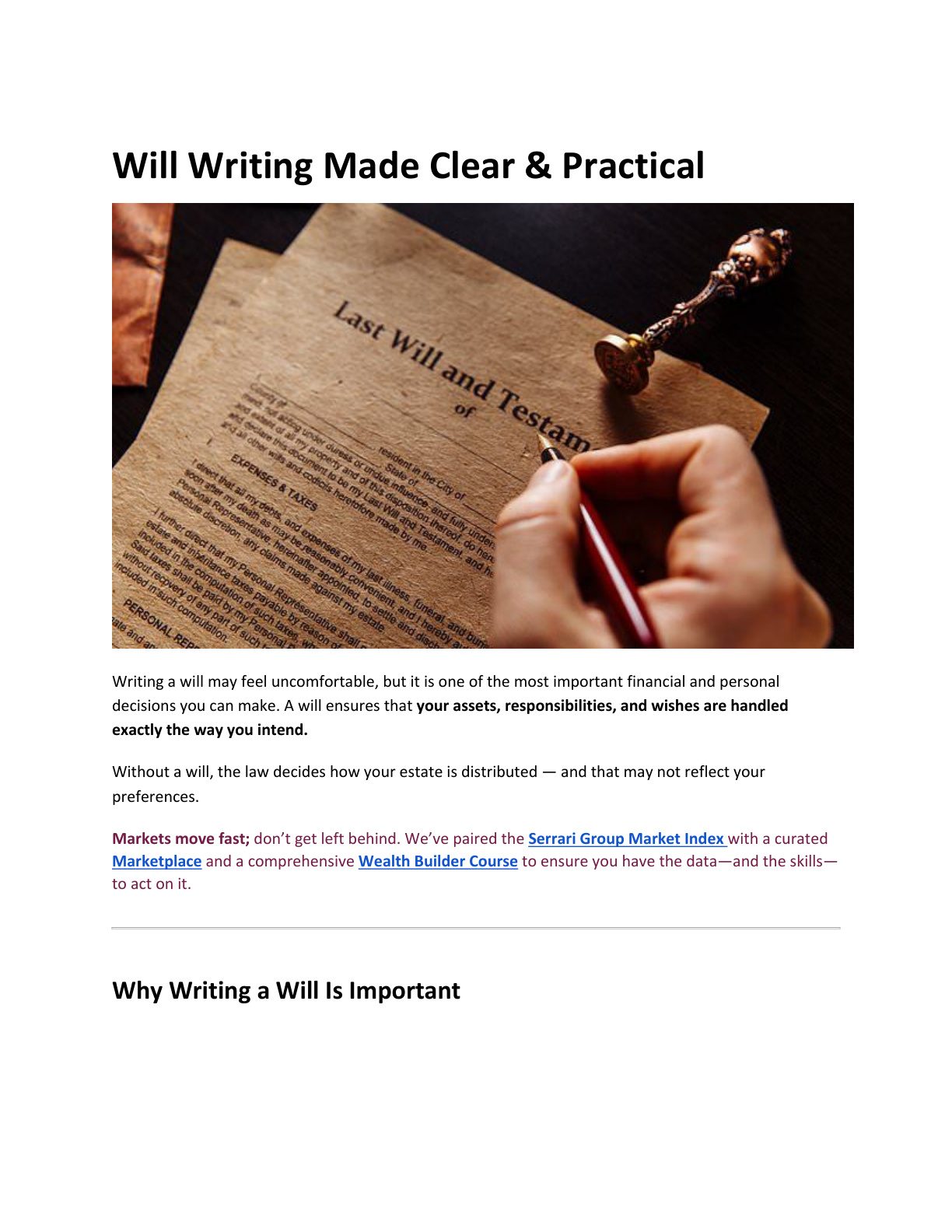
Wealth distribution ensures that what you build goes where you intend — not to the courts, the taxman, or family disputes. In Kenya, intestate succession (dying without a will) can tie up estates in court for years, with assets sometimes lost entirely to legal fees, administrative costs, or contested claims. Estate planning is not optional for serious wealth builders; it is foundational.
The core components of estate planning in Kenya: A legally valid will — directs the distribution of all named assets to specified beneficiaries. Trusts — protect assets for minors, business continuity, or multi-generational wealth transfer. Beneficiary designations — ensure that bank accounts, life insurance policies, and pension funds transfer immediately outside of probate. Letter of wishes — guides executors on non-legal preferences like funeral arrangements and family heirlooms.
The critical point: estate planning and wealth accumulation must run in parallel, not in sequence. Do not wait until you are wealthy to write a will. Any Kenyan with assets, dependents, or a business interest should have a basic estate plan in place — starting with a will. The cost of drafting a will is minimal; the cost of dying without one, measured in family conflict, lost assets, and legal fees, is enormous.
Build your full succession plan alongside your estate plan | Understand will writing in Kenya step by step
Reviewing and Rebalancing Your Wealth Strategy

Your wealth plan is a living document, not a one-time event. Markets shift, life circumstances change, and the Kenyan economic environment evolves — interest rates move, inflation fluctuates, new investment products emerge. A plan built five years ago may be entirely misaligned with your current goals and the current market reality.
Rebalancing means periodically adjusting your portfolio back to your target allocation when market movements shift the weightings. For example: if equities surge and grow from a targeted 40% to 55% of your portfolio, you are now overexposed to equity risk. Rebalancing means trimming equities and buying more of your underweight assets to restore the original balance.
When should you review your wealth plan? Annually at minimum — set a fixed date such as the first week of January. Also review immediately after any major life event: marriage, divorce, birth of a child, inheritance, career change, business acquisition, or a sharp change in income. This annual review discipline — tracking progress against goals, rebalancing allocations, updating insurance cover, and reviewing estate documents — is the single habit that separates disciplined wealth builders from passive savers.
Learn how professionals approach portfolio rebalancing | Explore smart investing strategies that reward regular review
Investment Tools Available to Kenyan Investors
Kenya offers a growing and accessible range of investment instruments for every wealth level and risk profile. Understanding each option helps you allocate purposefully rather than reactively — choosing tools because they fit your strategy, not because someone recommended them on a WhatsApp group.
Nairobi Securities Exchange (NSE) equities give you ownership stakes in listed Kenyan and East African companies — appropriate for long-term growth allocation. Treasury Bills (91-day, 182-day, 364-day) offer guaranteed, short-term, government-backed returns. Treasury Bonds (2 to 30 years) provide longer-term fixed income at attractive yields. Infrastructure Bonds are tax-exempt and popular with long-term wealth builders seeking tax efficiency. Real Estate Investment Trusts (REITs) offer property sector exposure without the capital requirements and management burden of direct property ownership. SACCOs provide member-owned savings and credit at competitive rates — particularly valuable for credit access at lower rates than commercial banks.
Money Market Funds deliver daily liquidity with returns consistently above bank savings rates — the most practical tool for emergency fund parking and short-term savings. Offshore investment platforms now enable Kenyan investors to access global equity markets through regulated brokers. Match each tool to a specific goal in your wealth plan and understand its role before committing capital.
Compare investment tools and their expected returns | Understand how to build a diversified investment portfolio
Wealth Allocation by Life Stage: Your Roadmap
Your optimal wealth allocation shifts as you move through life. What works at 25 is inappropriate at 55. Understanding your life-stage roadmap prevents the twin errors of being too conservative when young (sacrificing compounding growth) and too aggressive when older (risking capital you cannot afford to lose).
Your 20s — Foundation Phase: Priority is building an emergency fund, eliminating high-interest debt, and starting long-term investment contributions — even KES 2,000 per month in a pension or equity fund. Your allocation can afford 70% growth assets (equities, SACCOs) and 30% stable assets. Time is your greatest advantage; use it aggressively.
Your 30s — Acceleration Phase: Stable income, potentially a family, and bigger financial goals. Maximise retirement contributions, begin property acquisition, and write your first will. Allocation shifts to roughly 60% growth, 40% stable. Your 40s — Consolidation Phase: Your largest wealth-building window. Maximise pension contributions, pay down mortgage debt, and update your estate plan. Allocation: 50% growth, 50% stable. Your 50s and beyond — Distribution Phase: Capital preservation becomes as important as growth. Reduce equity exposure, increase fixed income and annuities, and finalise estate documents. Allocation: 30% growth, 70% stable income-generating assets.
Start your succession plan early to protect each life stage | Match your investment tools to your life-stage allocation
Common Wealth Management Mistakes Kenyans Make
Understanding common errors helps you avoid them before they cost you years of progress. The most prevalent wealth management mistakes in Kenya share a common thread: reactive rather than strategic financial behaviour.
No written plan — most Kenyans manage money reactively, responding to financial events without a strategy. Keeping all savings in a current or savings account — inflation erodes the real value of idle cash over time, effectively shrinking your wealth. Ignoring insurance — many Kenyans have no life or health cover, leaving their entire wealth exposed to a single adverse event that could erase decades of accumulation. Failing to account for inflation — a return of 8% is effectively negative if inflation runs at 9%.
Timing the market — trying to predict market movements leads to emotional, ill-timed trades that destroy returns. Not updating estate documents — wills and beneficiary designations made before marriage, children, or major asset acquisitions become dangerously outdated. Taking investment advice from unqualified sources — social media tips, WhatsApp groups, and informal investment clubs have cost Kenyans billions through fraud and poor decisions. Awareness of these traps is the first step to avoiding them.
Understand how savings, investments, and insurance work together | Learn from timeless wealth principles that have stood the test of time
Working With Financial Professionals in Kenya
You do not have to manage wealth alone. Kenya has a growing ecosystem of licensed financial professionals who can provide expert, regulated advice tailored to your specific situation, goals, and risk profile. The right professional relationship saves you far more than it costs.
Types of professionals and their roles: Certified Financial Planners (CFPs) — provide holistic wealth management plans covering investment, insurance, tax, and estate needs in an integrated framework. Licensed Investment Advisors — registered with the Capital Markets Authority (CMA) to provide advice on securities and portfolio construction. Estate Planning Attorneys — draft legally valid wills, trusts, and succession documents under Kenyan law. Tax Consultants (CPAs, ACCAs) — optimise your tax position on income, capital gains, and estate transfers. Fund Managers — manage collective investment schemes (money market funds, unit trusts) on your behalf.
How to vet a financial professional in Kenya: Verify CMA registration at cma.or.ke. Check ICPAK membership for accountants and CPAs. Ask for their fee structure upfront — fee-based advisors have fewer conflicts of interest than commission-based ones. Request references from existing clients with similar wealth profiles. Never hand money to an advisor without a formal, written engagement agreement that specifies their obligations, fee structure, and your rights.
Understand investments deeply before engaging a fund manager | Prepare your estate plan alongside your investment strategy
Key Takeaways
Smart wealth management in Kenya is a lifelong discipline built on five connected practices that reinforce each other over time.
First, set SMART goals that define exactly what you are building and by when — your goals are the compass for every financial decision you make. Second, allocate assets across growth and stable instruments in proportions matched to your age, income, and risk profile — and rebalance at least annually to stay on target. Third, protect everything you build with appropriate life, health, and property insurance before you need it — the cost of a claim always exceeds the cost of coverage. Fourth, start retirement contributions early and maximise every employer-matching opportunity — compound interest rewards patience exponentially and punishes delay harshly. Fifth, plan your estate from day one — a will, beneficiary designations, and succession documents are not optional extras for the wealthy; they are essential tools for anyone with assets and dependents.
The Kenyan financial ecosystem — NSE, Treasury instruments, money market funds, SACCOs, licensed advisors — provides everything you need to build, protect, and distribute wealth effectively. Your job is to use these tools intentionally, review your strategy regularly, and seek qualified advice when the stakes are high. Start now, stay consistent, and let time do the compounding.
Build your complete succession and estate strategy | Master the investment portfolio principles behind long-term wealth
Frequently Asked Questions
How much should I save versus invest each month? A practical starting framework is the 50/30/20 rule: 50% of take-home pay on needs (rent, food, utilities), 30% on discretionary spending, and 20% on savings and investments. As your income grows, increase the savings and investment percentage rather than expanding lifestyle costs proportionally.
What is the minimum amount needed to start investing in Kenya? Many money market funds accept as little as KES 1,000 as an opening deposit. NSE equities can be purchased in small lots through licensed brokers. There is genuinely no financial barrier to starting — only a psychological one. Begin with what you have and build from there.
How often should I review my wealth plan? At minimum annually — set a fixed date, such as the first week of every January. Also review immediately after any major life event: marriage, divorce, new child, inheritance, job change, or acquisition of significant new assets.
Is a SACCO better than a bank for savings? SACCOs typically offer higher dividend returns on member savings and access to loans at substantially lower rates than commercial banks. However, SACCOs are less liquid — you may not access funds immediately. The optimal approach is to use both: a money market fund for liquid emergency savings and a SACCO for disciplined long-term accumulation and credit access.
When should I start estate planning? Immediately. Estate planning is not reserved for the elderly or the wealthy. Any Kenyan with assets, dependents, a business interest, or existing financial accounts should have a valid will and updated beneficiary designations in place. The cost of a basic will is minimal compared to the cost of intestate succession — measured in financial loss, legal fees, and family conflict.
Begin your estate planning journey with a full succession plan | Understand will writing in Kenya step by step