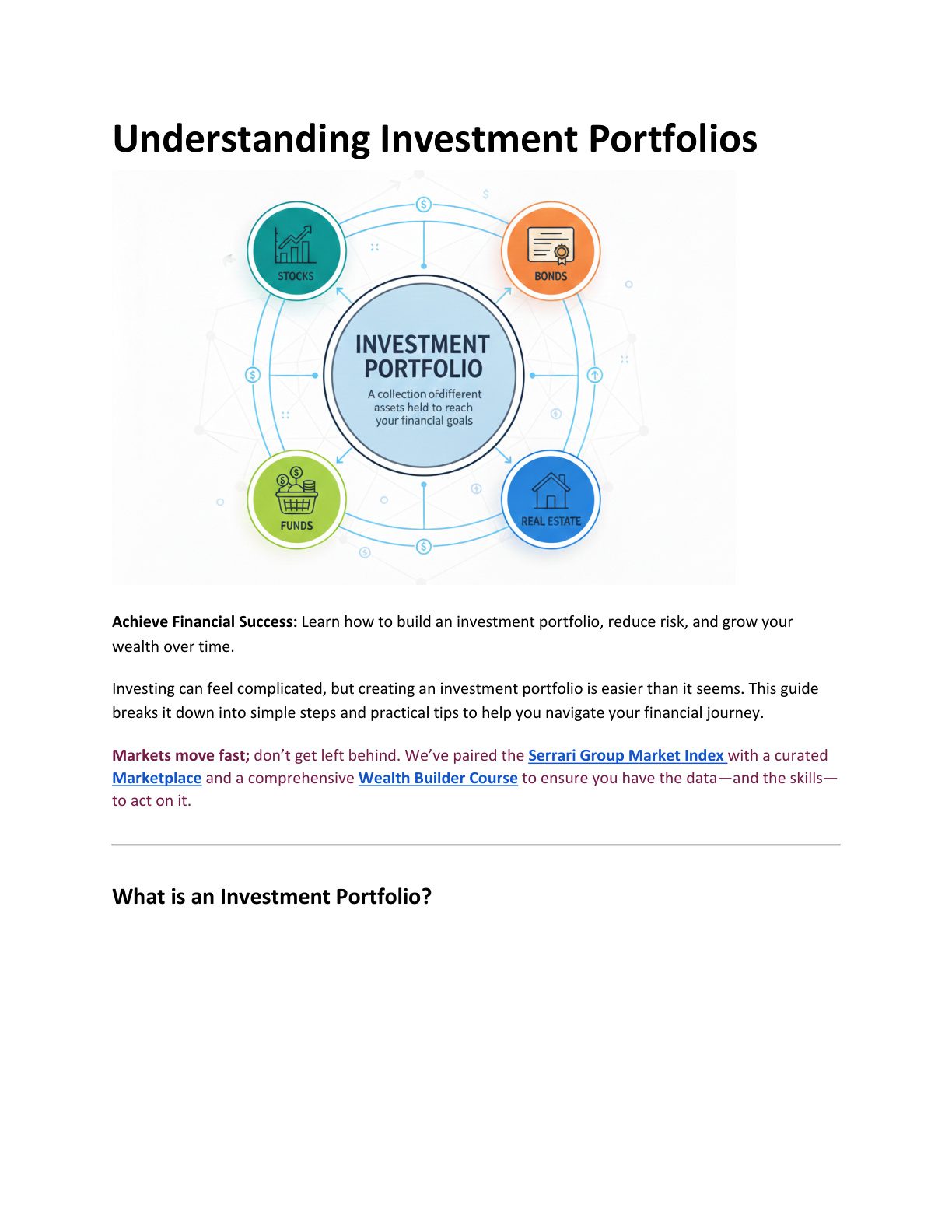
Smart Investing: A Guide to Stocks, Bonds & Real Estate
Practical Guidance on Stocks, Bonds, Real Estate, and Kenyan Investment Vehicles
Making smart investment decisions starts with understanding how each product works. This guide covers every major investment product available to Kenyan investors — from NSE equities and government bonds to real estate, SACCOs, and cryptocurrencies — with practical advice on choosing what fits your goals.
What You'll Learn
- NSE equities offer CGT-free capital gains and dividend income for Kenyan investors
- Government T-bills and bonds yield 13-17% — among the best risk-adjusted returns in Africa
- Real estate investment ranges from direct property to NSE-listed REITs from KSh 2,000
- SACCOs offer 8-12% returns with cooperative ownership benefits unique to Kenya
- Money Market Funds provide 10-14% returns with daily liquidity and CMA regulation
- Cryptocurrencies are high-volatility assets — limit to under 5% of any portfolio
Why Investment Product Selection Matters

Investment product selection is not an abstract academic exercise — it is one of the most consequential financial decisions a Kenyan makes. Choosing the wrong product for your situation can mean: earning 3% on a bank savings account when government T-bills are paying 16%; locking capital into an illiquid property investment when you need funds within two years; taking on equity volatility within 12 months of a major financial goal; or concentrating all savings in a single SACCO that later faces governance problems.
Each investment product has a specific purpose, risk profile, return expectation, liquidity characteristic, and tax treatment. Understanding these dimensions for every product you hold is the foundation of intelligent investing.
The Kenyan investment market as of 2024-2025 offers an unusually rich set of opportunities for retail investors. Government securities yield 13-17% — extraordinary by global standards. The NSE provides CGT-exempt equity returns. Money Market Funds yield 10-14% with daily liquidity. SACCOs offer cooperative returns of 8-12%. REITs provide real estate exposure from KSh 2,000. These products, combined intelligently, can generate total portfolio returns of 12-16% annually — transformative over a 20-30 year horizon.
This guide walks through each product category in detail, with specific Kenyan context, practical entry information, and guidance on how each fits into an overall investment strategy.
For the foundational investment framework that contextualises all product choices, read Understanding Investments and The Difference Between Savings, Investments, and Insurance.
Stocks — Equity Ownership on the NSE and Beyond

A stock (also called a share or equity) represents a fractional ownership stake in a company. When you buy Safaricom shares, you become a partial owner of Safaricom PLC — entitled to a proportional share of its profits (paid as dividends) and any increase in the company's value over time (capital appreciation).
The Nairobi Securities Exchange (NSE) lists 61 companies across banking, manufacturing, agriculture, telecom, energy, and insurance as of 2024. The NSE is East Africa's most liquid stock exchange and is regulated by the Capital Markets Authority (CMA). Key Kenyan blue-chip stocks include Safaricom (telecom, KSh 15-20 price range), Equity Group Holdings (banking, KSh 38-50), KCB Group (banking, KSh 30-45), East African Breweries (consumer goods, KSh 130-180), and Bamburi Cement (manufacturing, KSh 40-60). These companies combine stable dividend yields (3-8%) with long-term capital appreciation potential.
To buy NSE shares, you need: (1) A CDS (Central Depository and Settlement) account opened through any licensed stockbroker — Faida Securities, AIB-AXYS, Dyer & Blair, Standard Investment Bank, or Sterling Capital. The process is largely digital and takes 2-5 business days. (2) A trading account with your chosen broker. (3) Funding from your bank account. Minimum trade sizes vary but most blue-chips are accessible from KSh 5,000-15,000 for a meaningful initial position.
Transaction costs on the NSE: buyer pays approximately 2.1% of trade value (broker commission + CMA levy + CDSC fee + stamp duty). Seller pays approximately 2.0%. Round-trip cost for a buy-and-sell transaction: approximately 4.1%. This cost structure makes NSE equities most suitable for medium-to-long-term holding — not frequent trading.
The critical Kenya-specific advantage: NSE equity gains are exempt from Capital Gains Tax (CGT) under the 2022 Finance Act. This makes Kenyan equities one of the most tax-efficient growth assets available to a Kenyan investor.
Risks: NSE equities are volatile. The NASI index has experienced corrections of 20-40% during economic downturns (2008, 2020, 2022). Individual stocks can fall 50-80% during company-specific crises. Equities should represent only the portion of your portfolio with a 5+ year investment horizon.
Understanding Investment Portfolios covers how NSE equities fit into a balanced allocation. Track your equity portfolio value with the Net Worth Calculator.
Bonds and Fixed Income — The Kenyan Government Securities Market

A bond is a debt instrument: the investor lends money to a borrower (government or company) for a defined period and receives fixed periodic interest payments (coupons) plus return of principal at maturity. Kenyan government bonds are among the most attractive fixed-income instruments in Africa due to their combination of government backing and high yields.
Treasury Bills (T-bills) are short-term instruments issued by the Kenyan government with tenors of 91 days, 182 days, and 364 days. They are sold at a discount to face value — you pay KSh 95 for a bill that matures at KSh 100. The difference is your return. Current T-bill yields: 91-day at 14-15%, 182-day at 15-16%, 364-day at 16-17%. These represent extraordinary risk-adjusted returns by global standards — backed by the full credit of the Kenyan government.
Treasury Bonds are longer-term instruments with tenors of 2, 5, 10, 15, 20, and 25 years. They pay semi-annual coupons at rates ranging from 13-16% depending on tenor and market conditions at issuance. Infrastructure Bonds are a special category — typically WHT-exempt on coupon income, making them particularly tax-efficient for individual investors.
Access: The Central Bank of Kenya (CBK) allows direct retail participation in T-bill and bond auctions through the DhowCSD mobile platform. Minimum investment: KSh 50,000 for T-bills and bonds. You can also access government securities through money market funds and bond-focused unit trusts at lower minimums.
Corporate bonds are a less developed but growing segment of the Kenyan market. Listed corporate bonds have historically been rare on the NSE, but the market is deepening. Corporate bonds carry higher credit risk than government bonds and should be approached with careful due diligence.
Withholding Tax: 15% WHT is deducted at source on T-bill discounts and bond coupon payments for resident investors. Infrastructure bonds are WHT-exempt. Factor this into your net return calculations — a 16% T-bill yields approximately 13.6% after 15% WHT.
Understanding Investments covers the full fixed-income landscape. The 50/30/20 Rule in Kenya shows how to allocate toward bonds within your monthly income framework.
Real Estate — Property Investment in Kenya

Real estate is the investment product that most Kenyans aspire to — and for good reason. Kenyan property has generated consistent long-term appreciation in urban and peri-urban areas, rental yields provide regular income, and property is a tangible asset that families value emotionally and structurally. However, direct property investment has specific requirements and risks that are widely underappreciated.
Direct property investment options in Kenya: (1) Residential rental property — purchasing a house or apartment for let. Rental yields in Nairobi range from 4-7% annually (as a percentage of property value), varying significantly by location. Lavington and Karen yield 4-5%; Kilimani and Westlands 5-6%; emerging suburbs like Ruaka and Athi River can yield 6-8% on well-purchased properties. Capital appreciation adds another 4-8% annually in high-demand areas, for total returns of 8-15%. (2) Commercial property — office space, retail premises, or warehousing. Higher yields (7-10%) but more complex management and higher tenant concentration risk. (3) Land — purchased for capital appreciation or future development. Peri-urban land in areas like Thika, Limuru, Athi River, and Kitengela has appreciated at 10-20% annually over the past decade in prime locations, but requires careful title deed verification and is fully illiquid.
The significant barriers to direct property investment: large minimum capital (KSh 3M-50M+ for most urban properties), illiquidity (6-18 months to sell in normal conditions), management burden (tenant selection, maintenance, legal disputes), and transaction costs (stamp duty at 4% of property value, legal fees 1-3%, agent fees 2-3%).
REITs (Real Estate Investment Trusts) offer real estate exposure without these barriers. The NSE lists Stanlib Fahari I-REIT (commercial real estate) and Acorn D-REIT (student accommodation). REITs trade like stocks on the NSE from as little as KSh 2,000-5,000 per unit, pay regular dividends from rental income, and are regulated by the CMA. For investors who want real estate in their portfolio without buying a physical property, NSE-listed REITs are the practical solution.
Understanding Investment Portfolios covers how real estate fits into a balanced allocation. Use the Savings Goal Tool to project savings timelines for property deposit targets.
Commodities and Precious Metals in the Kenyan Context

Commodities — physical assets including metals, energy products, and agricultural goods — serve a specific role in investment portfolios: inflation protection and diversification from financial assets. When equities and bonds fall simultaneously (as they did in 2022 globally), commodities often hold their value or appreciate, providing genuine portfolio diversification.
Gold is the most relevant commodity for Kenyan retail investors. Gold has historically served as: a store of value during currency depreciation (Kenya's shilling has depreciated over 70% against the USD since 2010 — gold priced in USD has more than doubled in the same period); a safe haven during political or economic uncertainty; and a partial hedge against inflation. Kenyan investors can access gold through: (1) Gold ETFs traded on international exchanges via offshore investment platforms or international unit trusts offered by Kenyan fund managers. (2) Physical gold — though storage security is a practical challenge. (3) Gold-linked investment products from some Kenyan banks.
Agricultural commodities are uniquely relevant to Kenya, which is a major producer of tea, coffee, cut flowers, and horticultural products. NSE-listed agricultural companies (Kakuzi, Williamson Tea, Rea Vipingo) provide indirect commodity exposure through equity ownership — capturing upside from commodity price rises while providing the liquidity and regulatory protection of listed equity. This is generally a more practical approach for retail investors than direct commodity trading.
Oil and gas have limited direct investment access for Kenyan retail investors. The nearest practical exposure is through energy sector stocks on the NSE (KenolKobil, Total Energies Kenya) or through international energy ETFs accessed via offshore investment platforms.
Commodities should represent a small allocation (5-10%) in most Kenyan portfolios — primarily gold as an inflation and currency hedge. They are not a core growth or income asset for most investors.
The Importance of Balancing Your Investment Portfolio explains how commodities fit into portfolio diversification strategy. For the full range of Kenyan investment instruments, see Understanding Investments.
Cryptocurrencies — High Risk, High Reward in Kenya

Cryptocurrency — digital assets using cryptographic blockchain technology — is the highest-risk major investment product category. Bitcoin, Ethereum, and thousands of alternative coins ("altcoins") have produced extraordinary returns in bull cycles and devastating losses in bear cycles. Bitcoin fell from approximately $69,000 in November 2021 to $16,000 in November 2022 — a 77% decline in 12 months. It subsequently recovered to new highs by 2024. This level of volatility is incompatible with any near-term financial goals.
Kenya has one of Africa's highest cryptocurrency adoption rates due to: widespread M-PESA mobile money infrastructure, a tech-savvy young population, and historical frustration with shilling depreciation driving interest in USD-denominated digital assets. Major cryptocurrency exchanges active in Kenya include Binance, Coinbase, and several local platforms.
The regulatory environment in Kenya remains evolving. The Capital Markets Authority has been developing a regulatory framework for virtual assets, but as of 2024 cryptocurrencies exist in a largely unregulated space. This means: no investor protection, no deposit insurance, no dispute resolution mechanism, and no guarantee of exchange solvency (several global exchanges collapsed with Kenyan investor funds in 2022-2023).
Practical risks specific to Kenyan crypto investors: exchange platform failures (Kenyans lost significant funds in FTX collapse), SIM-swap fraud targeting crypto wallets, unregulated "crypto investment schemes" promising unrealistic returns (20-50% monthly), and currency conversion costs when converting KES to USD for crypto purchases.
If you choose to invest in cryptocurrency: (1) Limit allocation to under 5% of your total investment portfolio — an amount you can afford to lose entirely. (2) Use only CMA-licenced or internationally regulated exchanges. (3) Hold cryptocurrency in a personal hardware wallet rather than leaving it on an exchange. (4) Invest only in the established top-two (Bitcoin, Ethereum) — altcoins carry additional project-specific risks. (5) Never use borrowed money or savings earmarked for specific goals to buy cryptocurrency.
Understanding Investments covers the full risk spectrum of investment products. Protect your core portfolio from high-risk allocations with a solid emergency fund — see How to Build an Emergency Fund in Kenya.
Money Market Funds and Unit Trusts — Accessible Kenyan Products
Money Market Funds (MMFs) and unit trusts are the most accessible and investor-friendly investment products available to Kenyan retail investors — and the starting point for the vast majority of first-time investors.
Money Market Funds pool investor deposits to purchase short-term, high-quality fixed-income instruments — primarily government T-bills, bank deposits, and commercial paper. Current MMF yields: 10-14% annually, paid daily and compounding on your growing balance. Key features: minimum investment from KSh 100 (CIC MMF) to KSh 5,000, daily liquidity (withdrawals typically processed same-day or next-business-day), CMA regulation, and relatively stable unit prices with very low volatility. Leading MMFs: CIC Money Market Fund, Old Mutual Money Market, Sanlam MMF, NCBA MMF, Cytonn Money Market.
Unit Trusts are professionally managed investment funds that pool investor money to buy a diversified portfolio of securities according to the fund's stated mandate. Types available in Kenya: (1) Equity funds: invest primarily in NSE-listed equities — highest long-term growth potential, highest short-term volatility. (2) Balanced funds: invest across equities, bonds, and money market — moderate growth with reduced volatility. The "portfolio in a box" solution for investors who prefer a single-product approach. (3) Bond/Fixed income funds: invest primarily in government and corporate bonds — lower volatility, steady income. (4) Money market funds: as described above.
Fund manager selection criteria: CMA licensing (verify at cma.or.ke), track record (minimum 5-year performance history), annual fund returns vs benchmark, total expense ratio (management fee + other charges — look for under 2% annually), minimum investment requirements, and withdrawal processing time.
Leading unit trust managers in Kenya: CIC Asset Management, Old Mutual Investment Group, Sanlam Investments, Britam Asset Managers, ICEA Lion, Madison Asset Management, Jubilee Financial Services.
Withholding tax on unit trust distributions is treated as dividends (5% WHT) rather than interest (15% WHT) for most funds — making them slightly more tax-efficient than direct fixed deposits.
Understanding Savings covers the savings instruments that complement MMF investing. Track your total investable portfolio with the Net Worth Calculator.
SACCOs and Cooperative Investments — A Uniquely Kenyan Advantage
Savings and Credit Cooperative Organisations (SACCOs) are one of Kenya's most distinctive and powerful financial institutions — and one of the most underappreciated investment products available to Kenyan investors. Kenya has one of the world's highest SACCO penetration rates, with over 14,500 registered cooperatives holding assets of over KSh 1 trillion.
A SACCO functions as a member-owned financial institution. Members pool savings and use the pooled capital to provide credit to each other at competitive rates. The financial returns for SACCO members come from: (1) Dividend on shares — typically 10-15% of par value annually, declared from surpluses. (2) Interest on deposits — most SACCOs pay 8-12% on deposit accounts, significantly above commercial bank savings rates. (3) Access to credit at 12% per annum — enabling members to borrow for productive purposes at rates far below commercial bank rates (18-26%).
Deposit-taking SACCOs (DT-SACCOs) are regulated by the SACCO Societies Regulatory Authority (SASRA), providing an important layer of investor protection. Non-deposit-taking SACCOs have lighter regulation — exercise more caution with these.
Types of SACCOs relevant to Kenyan investors: (1) Employer-based SACCOs — affiliated with specific employers (Harambee SACCO for civil servants, Kenya Police SACCO, Teachers SACCO). These are typically among the most financially stable, with automatic payroll deductions ensuring consistent member contributions. (2) Community-based SACCOs — open to specific communities, professions, or geographic areas. (3) Investment SACCOs — focused on accumulating capital for investment projects rather than credit provision.
Practical SACCO strategy: for salaried Kenyans, maximise SACCO contributions before adding complexity to individual investment portfolios. A SACCO offering 10-12% on deposits with access to credit at 12% (and the ability to borrow 3x your deposits) represents an extraordinarily attractive financial structure. Using the credit facility to finance productive investments (additional rental unit, business equipment, education) while your SACCO deposits continue earning 10-12% creates a form of financial leverage unavailable through any other regulated institution in Kenya.
Understanding Savings covers the SACCO savings framework in detail. The 50/30/20 Rule in Kenya guides how much of your income to direct toward SACCO contributions.
How to Evaluate Any Investment Product
Before committing capital to any investment product — whether a new unit trust, an offshore platform, a SACCO, or an NSE stock — a systematic evaluation framework protects you from costly mistakes.
The five essential questions to ask about any investment product:
Question 1 — Who regulates it? In Kenya, legitimate investment products are regulated by: the Capital Markets Authority (CMA) for capital market instruments (unit trusts, equities, bonds, MMFs), the Central Bank of Kenya (CBK) for bank deposits and T-bills/bonds, the SACCO Societies Regulatory Authority (SASRA) for deposit-taking SACCOs, or the Insurance Regulatory Authority (IRA) for insurance-linked investment products. Any investment claiming to be "unregulated but legitimate" or "regulated offshore" without verifiable registration in Kenya should be approached with extreme caution.
Question 2 — What is the source of the return? Every legitimate investment product has a clear, understandable source of return: equities derive returns from company profits and growth; bonds derive returns from interest on loans; real estate derives returns from rental income and property appreciation; MMFs derive returns from short-term lending to government and banks. If someone cannot clearly explain WHERE the promised return comes from in economic terms, it is almost certainly fraudulent.
Question 3 — What are the exact fees? Management fees, performance fees, entry fees, exit penalties, and transaction costs all reduce your net return. Always calculate the total expense ratio (TER) for fund products. Compare fees across similar products before committing.
Question 4 — What is the liquidity? How quickly can you access your money if you need it? Daily (MMF), on secondary market (NSE equities), at fixed intervals (bonds at maturity or secondary sale), with penalty (SACCO withdrawals, fixed deposits broken early), or not at all within a defined period (direct real estate, some private equity)?
Question 5 — Does it match your goals? A product offering 16% returns but with 3-year lock-up is inappropriate for a 1-year goal regardless of the return. Always match product characteristics to your specific goal requirements.
The Difference Between Savings, Investments, and Insurance provides the conceptual framework for evaluating all financial products. For a deep dive into investment analysis, see Understanding Investments.
Building a Multi-Asset Portfolio From These Products
The goal of understanding individual investment products is to combine them intelligently into a portfolio where each component plays a specific role and the combination produces better risk-adjusted returns than any single product alone.
A practical multi-asset Kenyan portfolio built from the products covered in this guide might look like this for a moderate-risk investor with a 15-year horizon and KSh 200,000 to invest:
Core holdings (80% of portfolio): (1) NSE equities via stockbroker — 35% (KSh 70,000). Select 5-7 large-cap, dividend-paying stocks across banking, telecom, and consumer sectors. Target: 8-15% annual return (dividends + appreciation). (2) Government T-bonds (5-10 year tenors) via DhowCSD — 25% (KSh 50,000). Target: 13-15% coupon yield, WHT-reduced to 11-13% net. (3) Balanced unit trust — 20% (KSh 40,000). Provides automatic diversification and professional management. Target: 10-13% annual return.
Supporting holdings (20% of portfolio): (4) Money Market Fund — 15% (KSh 30,000). Liquidity anchor and rebalancing reservoir. Current yield: 10-14%. (5) SACCO deposits — 5% (KSh 10,000). Cooperative returns and access to credit facility.
Expected weighted portfolio return: approximately 11-14% annually, with lower volatility than a 100% equity position and higher returns than a 100% fixed-income position.
As the portfolio grows to KSh 1M+, introduce: REITs for real estate exposure (5-10%), international unit trusts for geographic diversification (5-10%), and potentially infrastructure bonds for WHT-exempt fixed-income returns.
The beauty of building from multiple products is the natural rebalancing that occurs: dividends from equities top up the MMF; MMF returns are deployed into T-bill purchases; T-bill maturities fund new equity purchases during corrections. The portfolio becomes a self-sustaining wealth-building system.
The Importance of Balancing Your Investment Portfolio covers the rebalancing mechanics. Understanding Investment Portfolios provides the full construction framework.
Kenyan Investment Platforms and Access Points
Knowing which products to invest in is only valuable if you know how to access them. Kenya's investment infrastructure has expanded dramatically, with many products now accessible via smartphone.
NSE Equities access: Open a CDS account through any of these licensed stockbrokers: Faida Securities (online platform, low minimum), AIB-AXYS Africa (digital trading available), Dyer & Blair (longest-established, strong research), Standard Investment Bank (SIB), Sterling Capital, or Apex Africa. The NSE CDSC account opening process is now digital at cdsckenya.co.ke with National ID and KRA PIN.
Government Securities (T-bills and Bonds): The Central Bank of Kenya DhowCSD platform at cbk.go.ke allows direct retail participation in weekly T-bill auctions and bond issuances. Minimum: KSh 50,000. Payment via RTGS or Pesalink. Alternatively, access government securities through MMFs (no minimum) or bond-focused unit trusts.
Money Market Funds: Download the fund manager's mobile app (CIC Mobile, Britam App, Old Mutual App) or visit their website. Registration typically requires National ID, KRA PIN, and a bank account. Funding via M-PESA Paybill or bank transfer. Most platforms allow online withdrawals back to your registered bank account.
Unit Trusts: Same platforms as MMFs — most fund managers offer both products. Online subscription and redemption forms available. Some SACCOs also distribute unit trust products to their members.
REITs: Traded on the NSE like ordinary shares. Access through your stockbroker's trading platform. Search for "FAHR" (Fahari I-REIT) or "ACSS" (Acorn D-REIT) on the NSE trading system.
SACCOs: Join through your employer's recommended SACCO, a community SACCO, or a sector-based SACCO. Visit SASRA's directory at sasra.go.ke to verify regulatory status before joining.
International platforms (for USD-denominated assets): Britam, Old Mutual, and CIC offer Kenya-registered international unit trusts with USD exposure. For direct offshore investing, platforms like Interactive Brokers accept Kenyan retail clients with proper documentation.
Understanding Investments covers the full investment instruments landscape. Track all your positions across platforms with the Net Worth Calculator.
Common Mistakes When Choosing Investment Products
Product selection errors are among the most costly mistakes Kenyan investors make — and most are avoidable with basic awareness.
Choosing based on promised returns alone is the most dangerous mistake. When an investment product promises 20% monthly returns, 30% quarterly, or "guaranteed" returns above 20% annually with no risk explanation, it is almost certainly a fraud or a Ponzi scheme. Between 2018 and 2023, numerous Kenyan investment platforms collapsed with investor funds: Deci, Jenga, MMB, Velox, and others. The combined losses ran into hundreds of millions of shillings. The promised returns that attracted these investors were 5-20x legitimate market returns. The rule is absolute: verified legitimate investments in Kenya yield 10-18% annually. Nothing above this is achievable without commensurately higher risk.
Holding cash in a bank savings account as a long-term "investment": standard Kenyan bank savings accounts pay 2-4% annually. With inflation at 6-8%, real returns are negative. Every month that savings sit idle in a bank account rather than in a Money Market Fund (paying 10-14%) represents a measurable loss of purchasing power.
Buying a single stock as a "portfolio": many Kenyan investors hold one stock — often their employer's stock or a tip from a friend — and consider themselves "invested." A single NSE stock can fall 50-80% due to company-specific factors (Uchumi, ARM Cement, Home Afrika have all experienced catastrophic declines). True equity investing requires 8-15 well-selected positions across multiple sectors.
Ignoring product costs: a unit trust charging 2.5% annually vs 1.5% annually produces meaningfully different outcomes over 20 years. On KSh 500,000 growing at 12% annually, the 1% fee difference costs approximately KSh 320,000 over 20 years. Always compare total expense ratios.
Missing the emergency fund prerequisite: investing in equities or long-term bonds WITHOUT a liquid emergency fund means you will likely be forced to sell at the worst time (during a market correction that coincides with a personal financial emergency).
Understanding Investment Portfolios reinforces correct portfolio construction principles. Ensure you have the emergency fund foundation before investing — see How to Build an Emergency Fund in Kenya.
Matching Investment Products to Your Time Horizon
Time horizon is the single most important variable in investment product selection. The right product for a 1-year goal is completely different from the right product for a 25-year goal, even if the investor's risk tolerance is identical.
For goals within 1 year (emergency fund, event savings, near-term expenditure): appropriate products are Money Market Funds and 91-day to 364-day Treasury Bills. Expected returns: 10-14%. These instruments offer daily-to-annual liquidity, minimal capital risk, and returns that comfortably beat inflation. NSE equities and T-bonds are NOT appropriate for 1-year goals — both carry capital risk that could result in having less than you invested when you need the money.
For goals 1-3 years out (vehicle purchase, home deposit, business capital): appropriate products are 1-year T-bills, 1-3 year T-bonds, SACCO term deposits, and conservative unit trusts. Expected returns: 12-15%. A small equity allocation (10-20%) can be added if the goal date has flexibility. Avoid illiquid products (direct real estate, multi-year infrastructure bonds without secondary market access).
For goals 3-10 years out (education fund, property purchase, medium-term wealth building): balanced allocation between equities (40-50%), bonds (30-35%), and money market (15-20%). Expected returns: 12-15% annually. Time horizon is sufficient to absorb equity corrections and benefit from multi-year compounding.
For goals 10+ years out (retirement, financial independence, generational wealth): this is the highest-growth allocation appropriate for most investors. Equities should dominate (60-80%), complemented by bonds for rebalancing and cash flow, and MMF as liquidity reservoir. Expected returns: 12-18% annually. The compounding effect at these return levels over 20-30 years produces life-changing outcomes.
A practical example: KSh 10,000 per month invested for 25 years. At 5% (bank savings): KSh 5.9M. At 12% (balanced portfolio): KSh 18.7M. At 15% (growth portfolio): KSh 32.5M. The product selection decision — not the contribution amount — drives the majority of this outcome difference.
Savings Goal Tool calculates exactly how much your target product mix will grow over your chosen horizon. The 50/30/20 Rule in Kenya structures how much of your income flows to each time-horizon bucket.
Key Takeaways
Intelligent investment product selection is not about finding "the best investment" — it is about matching the right products to your specific goals, time horizons, risk tolerance, and financial situation. The critical takeaways for Kenyan investors:
Kenya offers exceptional investment products at every risk level. Government T-bills (14-17% with government backing), Money Market Funds (10-14% with daily liquidity), NSE equities (CGT-exempt, 8-15% long-term returns), SACCOs (8-12% with cooperative benefits), and REITs (real estate from KSh 2,000) — Kenyan investors have access to a world-class product set without needing offshore accounts or complex instruments.
Every product has a specific role. MMFs are for liquidity and short-term goals. T-bills and bonds are for income and medium-term stability. NSE equities are for long-term capital growth. REITs and real estate are for inflation protection and income. SACCOs are for disciplined savings and affordable credit access. Cryptocurrencies and commodities are for small speculative and hedge allocations only.
Time horizon determines product suitability more than anything else. The right product for 1 year is almost never the right product for 20 years, and vice versa. Match every investment explicitly to a goal and time horizon.
Costs compound against you. High management fees, transaction costs, and unnecessary tax drag reduce long-term returns significantly. Compare total expense ratios, choose tax-efficient products (NSE equities for CGT exemption, MMFs for 5% vs 15% WHT), and minimise unnecessary trading.
Fraud is a constant risk. Any product promising above-market returns without clear explanation of the return source is highly likely to be fraudulent. Verify CMA, CBK, SASRA, or IRA registration before investing. Never invest based on social media endorsements or unverified referrals.
Understanding Investment Portfolios shows how to combine these products into a coherent strategy. For the foundational framework, see The Difference Between Savings, Investments, and Insurance.
Frequently Asked Questions
Which investment product should a Kenyan beginner start with? A Money Market Fund from a CMA-regulated fund manager is the optimal starting product for most Kenyan beginners. Minimum investment from KSh 100-5,000, current yields of 10-14%, daily liquidity, government-backed underlying assets, and simple digital access make it the ideal first investment. Once the emergency fund is fully funded in the MMF (3-6 months of expenses), begin directing additional contributions toward a balanced unit trust or direct NSE equity purchases.
Are government T-bills better than Money Market Funds? T-bills (14-17% yield currently) do offer higher nominal yields than most MMFs (10-14%). However, T-bills require a minimum of KSh 50,000 and lock capital for 91-364 days. MMFs offer daily liquidity from KSh 100. For most retail investors, the liquidity advantage of MMFs outweighs the yield premium of T-bills for their liquid savings. Many MMFs hold significant T-bill allocations internally, capturing most of the T-bill yield while maintaining daily liquidity for investors.
How much money do I need to buy NSE shares? Technically, you can purchase shares in any amount above the broker minimum order (typically 100 shares minimum). At current prices, 100 Safaricom shares cost approximately KSh 1,500-2,000; 100 Equity Group shares cost KSh 3,800-5,000. A practical first equity position with meaningful diversification across 5 stocks requires approximately KSh 50,000-100,000. For smaller amounts, equity unit trusts provide better diversification at lower minimums.
Is real estate still a good investment in Kenya in 2025? Real estate remains a strong long-term investment in Kenya for investors who can meet the capital requirements and manage the illiquidity. Rental yields of 4-8% plus appreciation of 5-10% in strong urban locations produce total returns comparable to a balanced financial asset portfolio. The key risk is capital concentration — most Kenyans who invest in property put nearly all their financial assets into a single property, creating enormous concentration risk. REITs solve this by providing real estate exposure without concentration or illiquidity.
What is the safest investment in Kenya with the best returns? The safest investment with the best returns is 364-day Treasury Bills, currently yielding 16-17% with full government backing. For investors needing daily liquidity, Money Market Funds at 10-14% offer the best risk-adjusted return. Both options significantly outperform bank savings accounts while carrying minimal credit risk.
Understanding Investments is the essential companion for deeper product knowledge. Monitor all your investments in one place with the Net Worth Calculator.