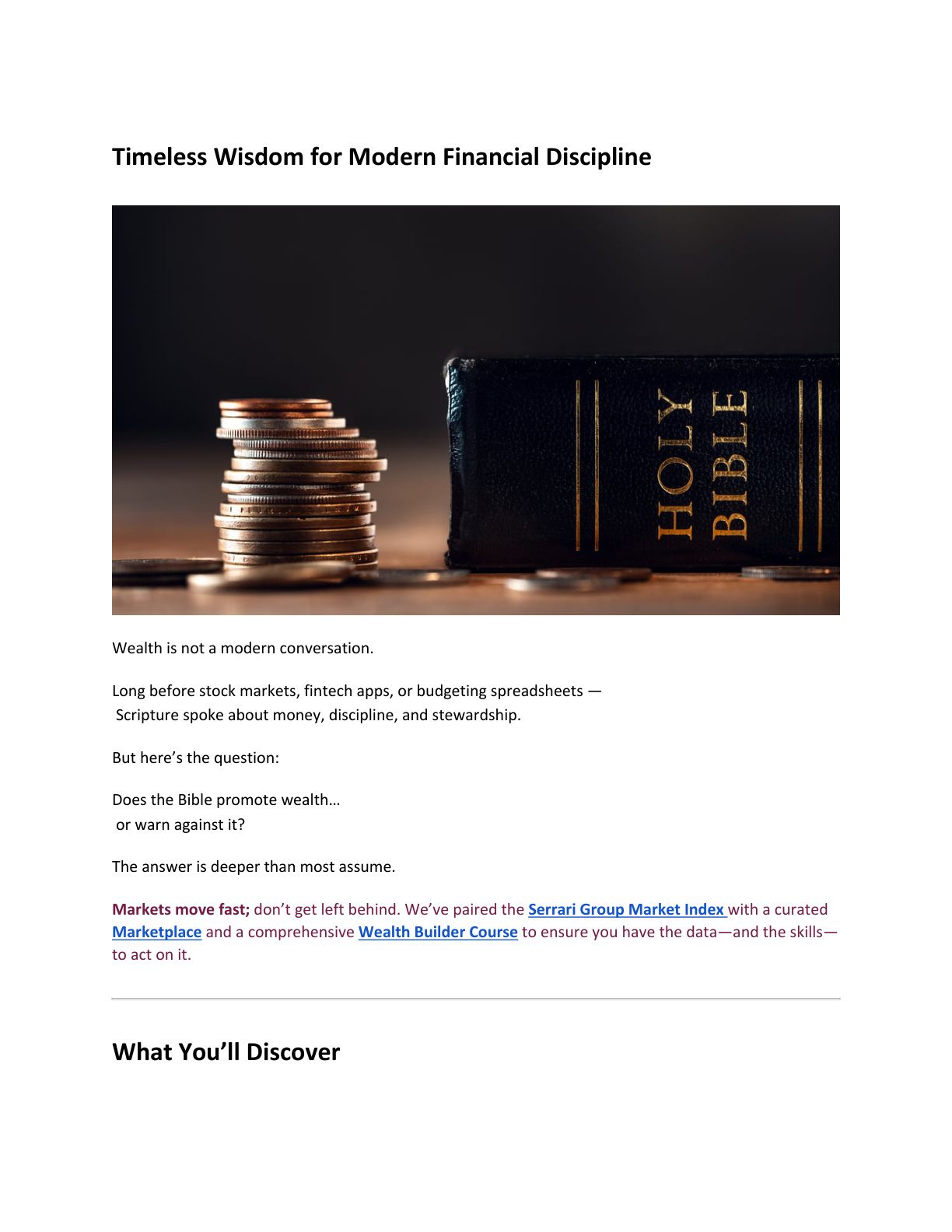
What Timeless Minds Teach Us About Managing Money
Wealth creation gets attention. Wealth management builds legacy.
The world's greatest investors and thinkers rarely speak about getting rich. They speak about discipline, preservation, patience, and structure. Discover six powerful wealth management principles and learn to apply them in the Kenyan context.
What You'll Learn
- Why wealth management matters more than wealth creation
- Six principles from Buffett, Rockefeller, Munger, Franklin, Carnegie, and Dalio
- Additional wisdom from Lynch, Marks, and Bogle
- The universal patterns all great wealth managers share
- Applying these principles to your Kenyan financial portfolio
- Building your personal wealth management framework
What Timeless Minds Teach Us About Managing Money

Wealth creation gets attention. Wealth management builds legacy.
Most financial conversations focus on how to get money — higher income, better investments, faster returns. Far fewer conversations address what to do with money once you have it. Yet it is the management of wealth, not merely its creation, that determines whether financial success becomes a lasting legacy or a temporary condition.
The world's greatest investors, entrepreneurs, and thinkers have understood this distinction deeply. Their quotes are not about getting rich quickly. They are about preserving capital, allocating wisely, exercising patience, building knowledge, and thinking generationally.
In this guide, we examine six core wealth management principles drawn from history's greatest financial minds and apply each one to the Kenyan financial context — translating timeless wisdom into concrete decisions you can make today.
Ground your wealth management in a solid financial foundation: Introduction to Personal Financial Planning provides the complete framework before you begin building your portfolio.
For the foundational rule that connects all these principles: The Golden Rule of Personal Finance — spend less than you earn and invest the difference, every time.
Wealth Creation vs. Wealth Management — Why the Difference Matters
Most people treat wealth creation and wealth management as the same thing. They are fundamentally different disciplines, and confusing them is one of the most expensive mistakes in personal finance.
Wealth creation is the process of generating income and accumulating assets. It involves career growth, business development, salary increases, and making initial investments. Most financial advice targets wealth creation — earn more, invest more, save more.
Wealth management is the process of protecting, structuring, and intelligently deploying assets over time to ensure they grow, endure, and serve your long-term goals. It requires capital preservation, diversification, allocation discipline, patience, cost minimisation, and legacy planning.
You can be excellent at wealth creation and catastrophically bad at wealth management. Kenya has many high earners — professionals, business owners, government officials — who have accumulated significant income over decades but have little or no lasting net worth because they managed their wealth poorly: no diversification, no preservation rules, no legacy plan, and constant lifestyle inflation that consumed every income increase.
The quotes in this guide specifically address wealth management. They provide the frameworks that make the difference between accumulating money temporarily and building wealth permanently.
Track your wealth management progress with the Net Worth Tracker — the foundational metric of wealth management, measuring what you own minus what you owe, updated monthly.
See how disciplined wealth management compounds over time using the Compound Interest Calculator — the mathematical case for why management discipline creates the most wealth long-term.
Warren Buffett — Preserve Before You Multiply
"Rule No.1: Never lose money. Rule No.2: Never forget Rule No.1." — Warren Buffett
This is the most quoted financial principle in investment history — and perhaps the most misunderstood. Buffett does not mean that losses never occur in a well-managed portfolio. He means that capital preservation must be the primary and overriding goal of wealth management. Before you optimise for returns, you must optimise against catastrophic losses.
The asymmetry of loss explains why. If you lose 50% of your portfolio, you need a 100% return just to return to your starting point. A 30% loss requires a 43% gain to recover. Protecting against large downside losses is therefore exponentially more valuable than chasing equivalent upside gains. This asymmetry is why great investors are risk-averse first and growth-oriented second.
Capital preservation in practice means:
Refusing to invest in things you do not genuinely understand — the unfamiliar investment that promises high returns is the most dangerous. Maintaining a substantial emergency fund so you never need to sell long-term investments at an unfavourable time due to a cash emergency. Diversifying across multiple asset classes so that no single failure is catastrophic. Being deeply sceptical of any investment that promises extraordinary returns with minimal risk — it reliably indicates either fraud or misunderstood risk.
In Kenya, capital preservation is threatened by: concentration in a single investment vehicle, cryptocurrency speculation without genuine understanding, placing funds in unregulated investment schemes promising above-market returns, and investing money you may urgently need before the investment matures.
Start with a fully funded emergency fund — the financial buffer that makes capital preservation structurally possible. How to Build an Emergency Fund in Kenya provides the complete framework.
Use the Savings Goal Calculator to plan your preservation buffer — calculating exactly how much you need and how long it takes to build at your current savings rate.
John D. Rockefeller — Discipline in Spending and Allocation
"Don't be afraid to give up the good to go for the great." — John D. Rockefeller
John D. Rockefeller, who built the largest personal fortune in American history by any proportional measure, understood that wealth management is fundamentally about trade-offs. Every allocation decision involves sacrifice — allocating capital to long-term investment means consuming less now. Resisting lifestyle inflation means forgoing the visible displays that feel good socially but drain the capital that should be compounding.
The "good" in Rockefeller's quote is comfortable, enjoyable present spending. The "great" is the exponentially larger outcome that patient, disciplined compound growth produces over decades. Choosing the great over the good — consistently and without exception — is the central behavioural discipline of wealth management.
In practice, this principle produces specific and measurable behaviours:
Investment contributions are set at the maximum sustainable percentage before lifestyle spending is determined — not the reverse. Large discretionary purchases (cars, renovations, celebrations) are evaluated against their impact on investment contributions, not just against available cash. Net worth is measured quarterly as the primary financial metric, not monthly income. Lifestyle upgrades are linked to investment milestones — not to income increases.
In Kenya, the greatest threat to this principle is social expectation: the cultural pressure to display financial success through visible consumption (cars, events, wardrobes, phone upgrades) rather than building invisible compound wealth. Rockefeller's principle is the direct counter-strategy: visible display is good; silent compound accumulation is great.
The 50/30/20 Rule in Kenya operationalises this principle — allocating income to savings and investments before discretionary spending, structurally embedding the "great over good" discipline into your monthly budget.
Use the Smart Spend Planner to review your monthly allocation and identify where the "good" is consuming capital that should be building the "great."
Charlie Munger — Patience and Simplicity Win
"The big money is not in the buying and selling, but in the waiting." — Charlie Munger
Charlie Munger, Warren Buffett's long-time partner and one of the most rigorous financial thinkers of the 20th century, identified the primary destroyer of investment wealth: overactivity. Most individual investors underperform the market not because of poor investment selection but because of excessive trading activity — buying and selling in response to market noise, emotional reactions to short-term price movements, and the psychological discomfort of watching a portfolio fluctuate without acting.
Each unnecessary transaction generates costs: management fees on every trade, capital gains taxes on profitable sales, bid-ask spreads, and the timing errors that compound destructively over time. But the more devastating cost is interrupting compound growth. Money withdrawn from a compounding investment does not resume compounding from where it left off — it starts over, having lost all the progress made while it was deployed.
The great investors — Buffett, Munger, Bogle, Lynch — hold positions for years or decades. They buy high-quality assets at reasonable prices and simply wait. The compounding works precisely because they do not interrupt it.
Munger's principle in wealth management practice:
Establish your asset allocation based on your goals and risk tolerance, then review it annually — not monthly. Resist the powerful temptation to sell when markets decline — this is precisely the wrong time to sell. Avoid switching between investment platforms chasing marginally higher rates. Let your investments run through their natural cycle without interruption. Judge investment performance over 5-10 year periods, not 3-month periods.
In Kenya, patience means: holding your money market fund position through rate cycles, not withdrawing from equity investments during NSE downturns, and letting Treasury Bond positions run to maturity. The investor who is still invested in 20 years will dramatically outperform the one who traded frequently in the same period.
See the mathematical proof of patience — use the Compound Interest Calculator to see what uninterrupted compounding produces versus compounding interrupted by periodic withdrawals.
For consistent capital to compound in a stable, daily-compounding vehicle, explore Money Market Funds in Kenya — the ideal first step for patient, long-term wealth accumulation.
Benjamin Franklin — Knowledge as the Ultimate Investment
"An investment in knowledge pays the best interest." — Benjamin Franklin
This principle has not merely held its value since Franklin wrote it in the 18th century — it has appreciated dramatically. In a world of increasing financial complexity, financial knowledge is the prerequisite for every other wealth management decision. Without it, you cannot evaluate investment vehicles, cannot assess risk, cannot detect fraud, cannot optimise for taxes, and cannot build a coherent portfolio.
The returns on financial knowledge compound through every financial decision you make for the rest of your life. The investor who understands compound interest starts saving at 25 instead of 35 — a 10-year compounding advantage that is worth more than any single investment decision. The investor who understands diversification avoids catastrophic concentration risk. The investor who understands valuations avoids asset bubbles. The investor who understands how money market funds work moves their cash from a zero-interest current account to a daily-compounding fund.
Each piece of knowledge eliminates an expensive mistake and enables better decisions — permanently, across every year of your financial life.
In Kenya, the returns on financial knowledge are especially high because financial literacy remains less widespread than it should be. The difference between an investor who understands how Treasury Bill auctions work and one who does not, is the difference between earning government-backed returns and earning nothing on the same capital. Understanding the difference between a money market fund and a current account can be worth hundreds of thousands of shillings over a decade on the same savings.
Financial education is not a one-time event. It is a weekly commitment to continuous learning that compounds into an increasingly powerful competitive advantage.
Explore the full library of financial guides at Introduction to Personal Financial Planning — a structured path through every dimension of personal financial management.
For an inspiring companion to Franklin's wisdom on knowledge, read the related principles in Timeless Wisdom for Modern Financial Discipline — ancient insights that align closely with this principle.
Andrew Carnegie — Wealth Management With Purpose
"The man who dies rich dies disgraced." — Andrew Carnegie
Andrew Carnegie, who built one of the greatest industrial fortunes in American history, gave away the vast majority of it — funding over 2,500 public libraries, universities, and cultural institutions. His statement was not false modesty or performance. It was the coherent conclusion of a wealth management philosophy that treated purpose and legacy as structural components of financial planning.
Wealth without purpose is fragile. Accumulated without a clear vision of what it is for, wealth creates anxiety about preservation, conflict over inheritance, and a hollow achievement that grows harder to enjoy as it grows larger. The accumulator who cannot answer "what is this for?" eventually finds that the wealth manages them rather than the reverse.
Wealth managed with purpose — with a clear vision of its role in your life, your family's future, and your community — becomes generative. It creates structures that outlast the original accumulator. It funds the next generation's opportunities. It builds something that means more than a number on a balance sheet.
In wealth management terms, Carnegie's principle produces specific decisions:
Developing a clear, written wealth purpose statement: what your financial assets are for and who they serve. Creating a formal legacy structure: will, estate plan, family investment policy, charitable giving strategy. Making investment decisions that align with values as well as returns. Planning for the intentional transfer of wealth across generations rather than leaving it to chance.
In Kenya, this principle connects directly to the deep cultural traditions of community building, educational investment, and family support. Wealth built with explicit purpose is more durable — it is protected and maintained by a wider circle of people who understand and share its mission.
For the biblical perspective that deeply aligns with Carnegie's legacy thinking, explore Timeless Wisdom for Modern Financial Discipline — which covers the scriptural principle of generational wealth building in depth.
The Net Worth Tracker is your monthly measure of whether your purposeful wealth plan is producing results — tracking both what you own and what legacy you are building.
Ray Dalio — All-Weather Diversification
"He who lives by the crystal ball will eat shattered glass." — Ray Dalio
Ray Dalio, founder of Bridgewater Associates — the world's largest hedge fund — built his entire investment philosophy on a single uncomfortable truth: no one reliably predicts the future. Not consistently, not across different economic cycles, not even the most sophisticated investors with the best information and the most advanced models.
The investor who believes they can time the market, predict recessions, call asset class rotations, or identify the next bubble before it inflates will, over time, be wrong at the most expensive possible moments. Market confidence correlates with overpricing; market fear correlates with underpricing. The investor who acts on predictions tends to buy confidence and sell fear — exactly the wrong behaviour.
Dalio's response was the "All-Weather" portfolio: a diversified asset allocation designed to perform acceptably across all economic conditions rather than maximally in any single scenario. Growth, recession, inflation, deflation — the All-Weather portfolio endures all four because its components respond differently to each economic environment.
The wealth management principles from Dalio:
Diversify across asset classes that respond differently to economic conditions — not just across companies within a single asset class. Never concentrate wealth in assets that all move together (true diversification, not the illusion of it). Build a portfolio that performs adequately in any scenario rather than spectacularly in one. Maintain systematic humility about your ability to predict the future — build resilience instead of relying on accuracy.
In Kenya, true diversification means building portfolio exposure across: money market funds (stability and liquidity), Treasury Bills and Bonds (government-backed, deflation-resistant), equities via the NSE or unit trusts (growth over the long term), and real assets — property or land (inflation-resistant, generational).
Explore Treasury Bills in Kenya for your government-backed, low-risk portfolio component — the anchor of an All-Weather Kenyan investment strategy.
Begin building your diversified foundation with Money Market Funds in Kenya — the liquid, stable component that provides both compounding returns and portfolio flexibility.
Additional Voices: Peter Lynch, Howard Marks, and John Bogle
Beyond the six primary voices, three additional wealth management thinkers offer principles that complete the picture.
Peter Lynch — Know What You Own:
"Know what you own, and know why you own it." — Peter Lynch
Lynch ran the Magellan Fund at Fidelity from 1977 to 1990, producing average annual returns of 29.2% — one of the best track records in investment history. His core principle was deceptively simple: understand every investment in your portfolio clearly. If you cannot explain in straightforward terms what an investment does, how it generates returns, and why it belongs in your portfolio — you should not own it.
In Kenya, this principle is protection against the hype-driven investments that are regularly marketed to ordinary investors: cryptocurrency schemes, offshore investment promises, complex structured products, and "guaranteed return" arrangements that no legitimate investment can sustain. If you cannot pass Lynch's test — explain it simply and clearly — do not invest.
Howard Marks — Price Discipline:
"The most important thing is not what you buy, but what you pay for it." — Howard Marks
Marks, co-founder of Oaktree Capital, argued that valuation discipline matters more than asset selection. A great business at an inflated price is a poor investment. A modest business at a heavily discounted price can be an outstanding one. Paying too much for a good asset — which most investors do at the peak of market enthusiasm — is one of the most reliable ways to destroy wealth.
In practice: avoid investing in trending assets at peak enthusiasm; seek value where others are not currently looking; and maintain price discipline even when a popular investment seems universally endorsed.
John Bogle — Cost Is the Enemy:
"In investing, you get what you don't pay for." — John Bogle
Bogle, founder of Vanguard and inventor of the index fund, made a career of reminding investors that costs compound just as powerfully as returns — but in the opposite direction. A 1% annual fee on an investment reduces your 30-year outcome by approximately 26% compared to the same investment at zero cost. Minimising investment costs — management fees, platform fees, transaction costs, fund expense ratios — is one of the most impactful wealth management decisions available to every investor.
Compare the fee structures of your current investments and find the lowest-cost vehicle available for your needs: Savings Accounts in Kenya provides a comprehensive comparison of rates and costs for your liquid savings.
For long-term compound growth with minimal cost and maximum accessibility, explore Money Market Funds in Kenya — among the most cost-effective wealth-building instruments available to Kenyan investors.
The Patterns Behind Timeless Wealth Management
Reading across Buffett, Rockefeller, Munger, Franklin, Carnegie, Dalio, Lynch, Marks, and Bogle — financial minds spanning three centuries, multiple countries, and diverse investment philosophies — the same patterns emerge consistently.
Pattern 1 — Preservation precedes growth: Before optimising for returns, protect against catastrophic losses. Capital is finite; time to recover from large losses is limited. Great wealth managers are risk-averse first and growth-oriented second.
Pattern 2 — Patience creates compound wealth: The investor who waits outperforms the investor who trades. Compound interest rewards uninterrupted time above all other investment qualities. The instinct to act during volatility is precisely the instinct that destroys the most wealth.
Pattern 3 — Knowledge is the prerequisite: You cannot manage well what you do not understand. Financial literacy is not optional — it is the foundation of every sound wealth management decision. Invest in it weekly, without exception.
Pattern 4 — Diversification is structural protection: No single asset class, investment, or market performs well in all conditions. True diversification across meaningfully different asset classes is the structural equivalent of insurance against catastrophic failure.
Pattern 5 — Purpose sustains management: Wealth managed with clear purpose — for family security, legacy, community impact — is maintained more carefully, for longer, and survives generational transfer more reliably than wealth accumulated without direction.
Pattern 6 — Costs compound destructively: Fees, taxes, and unnecessary transaction costs reduce the base on which returns are calculated. Minimising costs is as powerful as improving returns, and is much more within your control.
Not one voice in this guide says: predict markets, trade frequently, concentrate in trending assets, or accumulate without purpose. The universal message is the opposite of everything popular financial media celebrates.
For the wisdom counterpart that reinforces these same patterns from a different tradition, read What Successful People Say About Financial Planning — the personal finance principles that align directly with these wealth management frameworks.
Apply these patterns to your daily financial decisions using The Golden Rule of Personal Finance — the simplest expression of what all nine financial minds are pointing toward.
Applying These Principles in Kenya Today
Each of the six core principles from this guide translates directly into specific, actionable decisions available to every Kenyan investor today.
Buffett — Preservation: Build and maintain a fully funded emergency fund (three to six months of essential expenses) before maximising investment contributions. This protection removes the vulnerability that forces premature liquidation of long-term investments. Diversify across at least three asset classes — MMF, T-Bills, and equities — so no single failure is catastrophic.
Rockefeller — Allocation Discipline: Determine your maximum investment contribution percentage and set it up as an automatic transfer on payday — before any lifestyle spending is confirmed. Review your top five discretionary spending categories quarterly and identify one to reduce. Track net worth monthly as your primary financial metric, not monthly income.
Munger — Patience: Set up automatic contributions to your investment vehicles (MMF, Treasury Bills, equity) and then resist the urge to check them more than monthly. When market rates on MMFs fluctuate, do not switch platforms — the compounding you interrupt costs more than the marginal rate improvement you gain. Hold your positions.
Franklin — Knowledge: Commit to one financial education resource this week. Then make it a weekly habit. The compounding of financial knowledge over years produces better financial decisions than any single investment tip.
Carnegie — Purpose: Write one sentence describing what your wealth is for — what it enables and who it serves beyond yourself. Then write a basic will, or update the one you have. Open or contribute to a children's education fund, regardless of the current amount.
Dalio — Diversification: Map your current portfolio across asset classes. If more than 60% is in a single instrument or asset type, rebalance by directing new contributions to underweighted categories.
Explore the full range of Kenyan government securities at Treasury Bills in Kenya — the capital-preserving, low-risk foundation of a diversified Kenyan portfolio.
Build your allocation across Savings Accounts in Kenya for your liquid protection layer, and Money Market Funds in Kenya for your compounding growth layer.
Building Your Wealth Management Framework
Wealth management is not an activity reserved for the already wealthy. It is a set of disciplines that must be established early — because they are significantly harder to impose retrospectively on assets accumulated without structure.
Your wealth management framework has five components:
Component 1 — Asset Allocation: What percentage of your net worth is in each asset class? This must be a deliberate, written decision — not the accidental result of wherever your money happened to land. A practical starting allocation for a Kenyan investor: 15-20% liquid savings (high-yield savings account for emergency fund), 25-30% money market fund (daily compounding, full liquidity), 25-30% government securities (T-Bills and Bonds), 20-25% equity or real assets (NSE equities, unit trusts, or property), and 5% available for opportunistic allocation.
Component 2 — Preservation Rules: Under what conditions will you NOT liquidate long-term investments? Write these rules in advance. They must include: you will not sell equity positions during market corrections of less than X%; you will not withdraw MMF savings except for defined emergency categories; you will hold Treasury Bonds to maturity. Rules made in advance hold during moments of panic; rules made in the moment of panic do not.
Component 3 — Contribution Schedule: What specific amount goes to each investment vehicle on each payday? Automation removes willpower from the equation and ensures contributions happen regardless of motivation or circumstance.
Component 4 — Review Schedule: Quarterly review is the right cadence — frequent enough to catch significant drift from your target allocation, infrequent enough to prevent emotional overreaction to short-term noise. At each quarterly review: check actual versus target allocation; rebalance if any class has drifted by more than 10 percentage points; update your net worth calculation.
Component 5 — Legacy Plan: Every adult with financial assets should have: a written will specifying asset distribution; a named beneficiary on every financial account and insurance policy; and a clear record of all assets and their locations that your family can find when needed. This is the minimum responsible legacy plan.
Build your contribution framework with the Savings Goal Calculator — calculating exactly what monthly investment produces your target outcome at your expected return rate.
Track your wealth management outcomes with the Net Worth Tracker — the single most important measure of whether your framework is working.
Reflection and Self-Assessment
Before building or refining your wealth management framework, honest self-assessment is essential. Allocate five minutes to answer these questions truthfully:
Is your current portfolio genuinely diversified across meaningfully different asset classes, or concentrated in one or two instruments that tend to move together? Do you have written preservation rules that govern when you will not sell investments — or do you make those decisions in the moment of market stress? Have you calculated the total annual cost (fees, management charges, platform costs) of your current investments? Do you know exactly what percentage of your income goes to investments versus lifestyle spending — and did you choose that ratio deliberately? Do you have a clear wealth purpose statement — one or two sentences describing what your financial assets are for and who they serve? Have you created at minimum a basic will and named beneficiaries on your financial accounts?
If you answered "no" or "I don't know" to three or more of these questions, you have significant wealth management gaps to close — regardless of the size of your current portfolio. These gaps compound in their cost over time.
The principles in this guide — from Buffett to Dalio, from Franklin to Carnegie — are not complicated. But applying them requires honesty about where you currently stand, the discipline to build the right structures, and the patience to let those structures work over the years and decades they are designed for.
For the complete personal financial foundation that wealth management is built on, start with Introduction to Personal Financial Planning — the full framework from financial baseline to long-term strategy.
For a complementary philosophical approach that reinforces these wealth management principles from a different angle, read What Successful People Say About Financial Planning.
Key Takeaways
Wealth management is distinct from and more important than wealth creation. Creating wealth is the beginning — managing it with discipline, patience, knowledge, diversification, purpose, and cost awareness is what converts temporary financial success into lasting legacy.
The nine voices in this guide — Buffett, Rockefeller, Munger, Franklin, Carnegie, Dalio, Lynch, Marks, and Bogle — converge on six universal principles despite spanning three centuries: preserve before multiplying; allocate with discipline; wait with patience; invest in knowledge; manage with purpose; and minimise costs.
None of them endorse market timing, frequent trading, asset concentration, lifestyle inflation, or accumulation without direction. All of them describe structural, patient, knowledge-based wealth management as the path to lasting prosperity.
Applied in Kenya with the right vehicles — money market funds, Treasury Bills and Bonds, NSE equities, real assets — these principles are fully accessible at every income level and portfolio size.
Build your five-component wealth management framework: written asset allocation, preservation rules, automated contribution schedule, quarterly review cadence, and a basic legacy plan. Establish it before significant wealth accumulates — it is much easier to build the structure early than to impose it later.
Ground your daily financial discipline in The Golden Rule of Personal Finance — the simplest expression of what all nine great wealth managers are ultimately pointing toward.
Use the 50/30/20 Rule in Kenya to build the allocation discipline that Rockefeller's principle demands — structuring your income so investments are funded before lifestyle spending.
Frequently Asked Questions
What is the difference between wealth creation and wealth management?
Wealth creation is generating income and building assets — career growth, business income, salary increases, initial investments. Wealth management is protecting, structuring, and intelligently deploying those assets over time so they grow, endure, and serve your long-term goals. Most financial advice targets creation; this guide targets management — the discipline that determines whether financial success becomes lasting.
What does Buffett really mean by "never lose money"?
He means capital preservation is the primary goal of wealth management. The asymmetry of loss (a 50% loss requires a 100% gain to recover) makes protecting against large losses more valuable than chasing equivalent gains. In practice: diversify across asset classes, maintain an emergency fund, avoid investments you don't fully understand, and refuse to chase hype. Use the Compound Interest Calculator to see how large a loss needs to compound to recover — and why preservation matters so much.
How do I apply Dalio's diversification in Kenya with limited starting capital?
Begin with three instrument types: a money market fund for liquidity and daily compounding, Treasury Bills for government-backed stability, and a regular equity contribution through a licensed stockbroker or unit trust. Even 1,000-2,000 KES distributed across these three provides genuine diversification. As capital grows, add real assets. Explore Treasury Bills in Kenya to start your government-securities allocation.
How often should I review my wealth management portfolio?
Quarterly is optimal. Monthly reviews invite overreaction to short-term noise. Annual reviews miss meaningful drift from your target allocation. At each quarterly review: compare actual versus target allocation, update your net worth calculation, and consider rebalancing if any class has drifted by more than 10 percentage points from your target.
What is the minimum legacy plan every Kenyan adult should have?
At minimum: a written will specifying how your assets should be distributed; a named beneficiary on every financial account and insurance policy; and a clear written record of all your assets and their locations that your family can find when needed. This minimum takes a few hours to establish but provides enormous protection for everything you have built. It should be reviewed and updated every three to five years or whenever your financial position changes significantly.