Understanding Investment Portfolios
How to Build, Balance, and Grow a Portfolio That Works for You
An investment portfolio is your most powerful wealth-building tool — but only if it is built correctly. This guide walks Kenyan investors through every dimension of portfolio construction, from asset classes and risk tolerance to rebalancing and tax efficiency.
What You'll Learn
- Build across multiple asset classes to reduce risk and grow wealth
- Kenyan investors access NSE equities, T-bills, MMFs, REITs, and SACCOs
- Start with as little as KSh 1,000 through Unit Trusts or Money Market Funds
- Asset allocation drives 90% of long-term portfolio returns
- Rebalance annually to maintain your target allocation and manage risk
- Inflation-adjusted returns matter more than nominal gains in Kenya
What Is an Investment Portfolio?

An investment portfolio is a collection of financial assets — stocks, bonds, cash equivalents, real estate, funds, or alternative investments — held together with the deliberate goal of achieving a defined financial outcome. The key word is deliberate. A portfolio is not a random assortment of investments; it is a constructed system in which the individual components work together to generate returns while managing risk.
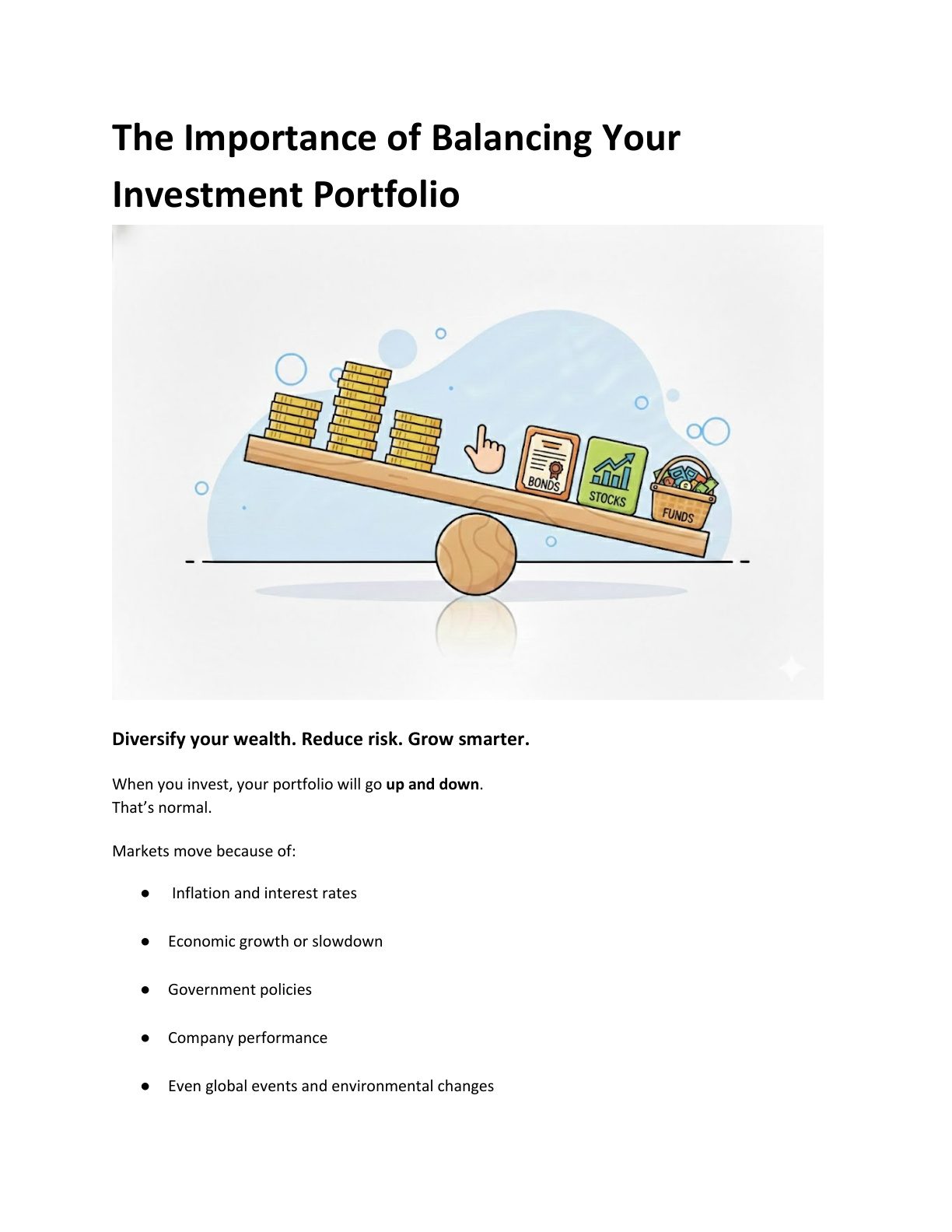
The concept rests on a foundational principle: different assets respond differently to economic conditions. When equity markets fall, government bonds often hold steady or rise. When interest rates spike, fixed-income instruments gain while equities may suffer. By holding a mix of assets whose performance is not perfectly correlated, you reduce the volatility of your overall wealth while capturing long-term growth from multiple sources.
A simple Kenyan example illustrates this. Imagine a KSh 500,000 portfolio distributed as follows: KSh 200,000 in NSE equities (40%), KSh 150,000 in a Money Market Fund (30%), KSh 100,000 in government Treasury Bills (20%), and KSh 50,000 in a unit trust (10%). During a period of equity market weakness, the MMF and T-bills continue earning 10-14% while the equity portion recovers. During equity bull runs, the NSE allocation drives outperformance. Together, the portfolio performs more consistently than any single component would alone.
The fundamental difference between a portfolio and simply "having investments" is intentionality — knowing what you own, why you own it, how much of each you should hold, and when to adjust.
For the foundational concept that underpins all portfolio decisions, read Understanding Investments and The Difference Between Savings, Investments, and Insurance.
Why Every Kenyan Needs a Portfolio

The most persistent myth about investment portfolios is that they are for wealthy people. The reality in Kenya is exactly the opposite: portfolios are most critical for people who cannot afford to lose what they have. When a wealthy individual makes a poor investment, it is a setback. When a middle-income Kenyan makes a poor investment with their savings, it can be catastrophic — wiping out years of sacrifice in months.
The second myth is that portfolios require large amounts to start. This is demonstrably false. The Nairobi Securities Exchange (NSE) allows purchases of as few as 100 shares — many blue-chip stocks trade between KSh 5 and KSh 50 per share. Money Market Funds accept deposits from KSh 100. Unit trusts are accessible from KSh 1,000. Even Treasury Bills, once only accessible to institutional investors, are now purchasable via mobile apps from M-Pesa-linked platforms with as little as KSh 50,000.
Kenya presents a specific case for portfolio building that differs from developed markets. First, inflation in Kenya averages 6-9% annually — significantly higher than many developed economies. Any savings sitting in a standard bank account (earning 2-4%) is losing real purchasing power every year. A portfolio that earns 10-15% annually in inflation-adjusted terms is not a luxury; it is a necessity for financial survival. Second, Kenya has a pension gap: NSSF contributions are mandatory but historically produce very low returns. Kenyans who rely solely on NSSF for retirement face a difficult outcome. A personal investment portfolio supplements this gap with potentially far higher returns.
Third, Kenya is an economy of compounding opportunity. The NSE NASI index has delivered average annual returns of approximately 8-12% over 20-year periods despite significant volatility. Money Market Funds currently yield 10-14% annually. These are genuine wealth-building returns available to any Kenyan with a CDS account or a unit trust subscription.
Build the emergency fund that protects your portfolio through downturns. Complement your portfolio strategy with a strong savings foundation at Understanding Savings.
The Five Steps to Building Your First Portfolio

Building a portfolio is a structured process, not a single decision. Each step informs the next, and skipping any step creates vulnerabilities that compound over time.
Step 1 — Define Your Goals. Every portfolio has a purpose. Common Kenyan investor goals include: building retirement savings (20-40 year horizon), accumulating school fees for children (5-15 year horizon), purchasing land or property (5-10 year horizon), creating passive income streams (ongoing), and building a wealth reserve (open-ended). Each goal has different return requirements, time horizons, and risk tolerances. A portfolio serving multiple goals should technically be structured as separate "buckets" — each with its own allocation and target.
Step 2 — Assess Your Risk Tolerance. Risk tolerance has two dimensions: financial capacity (how much can you afford to lose without derailing your goals?) and emotional tolerance (how much volatility can you withstand without panic-selling?). These are often different. A young professional earning KSh 200,000 per month with no dependants and a 30-year horizon has HIGH financial risk capacity. But if they check their portfolio daily and lose sleep during market corrections, their emotional tolerance is LOW. The portfolio should be built to the LOWER of these two dimensions.
Step 3 — Determine Asset Allocation. This is the single most important decision in portfolio construction. Research consistently shows that asset allocation — not individual stock picking — accounts for over 90% of long-term return variance. A conservative allocation might be 30% equities / 50% fixed income / 20% money market. A moderate allocation: 50% equities / 30% fixed income / 20% alternatives. An aggressive allocation: 70% equities / 20% alternatives / 10% fixed income.
Step 4 — Research and Select Specific Investments. Within each asset class, choose specific instruments: which NSE-listed stocks, which unit trust fund manager, which government bond tenor, which SACCO. Evaluate based on historical performance, fees (management charges matter enormously over 20 years), liquidity, and minimum investment requirements.
Step 5 — Monitor and Rebalance. A portfolio built today will drift from its target allocation over time as different assets grow at different rates. Annual rebalancing — selling outperformers and buying underperformers — restores the target allocation and systematically enforces "buy low, sell high" discipline.
Track your portfolio growth with our Net Worth Calculator and set milestone targets with the Savings Goal Tool.
Asset Classes Available to Kenyan Investors

Kenyan investors have access to a broader range of asset classes than most realise. Understanding what each offers — and its specific characteristics in the Kenyan context — is essential for building a well-constructed portfolio.
NSE Equities (Stocks) are ownership stakes in publicly listed Kenyan companies. As of 2024, the NSE lists 61 companies across banking, manufacturing, agriculture, telecom, energy, and insurance. Returns come from dividends (typically 3-8% annually for established companies) and capital appreciation. NSE equities offer the highest long-term growth potential but also the highest short-term volatility. Access requires a Central Depository and Settlement (CDSC) account, which any Kenyan can open through a licensed stockbroker.
Government Securities — Treasury Bills and Treasury Bonds — are debt instruments issued by the Kenyan government. T-bills are short-term (91-day, 182-day, 364-day) and currently yield 14-17%. Treasury Bonds are long-term (2-25 years) with coupon rates of 13-16%. These are among the safest investments in Kenya — backed by the full faith of the government — and can be purchased through the CBK DhowCSD mobile platform with a minimum of KSh 50,000.
Money Market Funds (MMFs) pool investor money to invest in short-term, high-quality fixed-income instruments. Current yields: 10-14% per annum. Key features: daily liquidity (most allow same-day or next-day withdrawals), low minimums (KSh 100-1,000), and FDIC-equivalent CMA oversight. Leading MMFs in Kenya include CIC Money Market Fund, Old Mutual Money Market, NCBA MMF, and Sanlam Money Market.
Unit Trusts and ETFs — professionally managed funds investing across equities, bonds, or balanced portfolios. Balanced funds offer a ready-made diversified portfolio for investors who do not want to manage allocations themselves. Management fees typically range from 1.5-2.5% annually, which must be factored into return expectations.
REITs (Real Estate Investment Trusts) allow investment in income-generating real estate without directly purchasing property. The NSE lists two REITs: Stanlib Fahari I-REIT and Acorn Student Accommodation D-REIT. They pay dividends from rental income and offer property exposure from as little as KSh 2,000 per unit.
SACCOs (Savings and Credit Cooperative Organisations) offer competitive fixed-deposit rates (8-12% annually) alongside access to credit at 12% interest. For Kenyans in formal employment, a SACCO allocation provides stable, government-supervised fixed-income returns that complement more volatile equity holdings.
Understand the full landscape of investment instruments at Understanding Investments. Budget your investment contributions using The 50/30/20 Rule in Kenya.
Understanding Risk Tolerance
Risk tolerance is the cornerstone of portfolio design — and the concept most investors misunderstand. It is NOT a fixed personality trait. It is a multi-dimensional assessment that combines your financial situation, time horizon, investment knowledge, and emotional response to loss. Getting this assessment wrong leads to two common and opposite disasters: portfolios so conservative they fail to beat inflation, or portfolios so aggressive they are abandoned in panic during downturns.
The three risk profile categories used by most Kenyan fund managers and financial planners are: (1) Conservative: primary goal is capital preservation; accepts 4-7% annual returns in exchange for low volatility; typically 10-30% equities, 60-80% fixed income, 10-20% money market. (2) Moderate: balances growth and preservation; accepts 8-12% target returns with moderate volatility; typically 40-60% equities, 30-40% fixed income, 10-20% money market. (3) Aggressive: prioritises long-term capital growth; accepts significant short-term volatility for 12-18%+ target returns; typically 60-80% equities, 10-20% alternatives, 5-15% fixed income.
Factors that pull TOWARD conservative: retirement within 10 years, sole breadwinner status, significant debt obligations, limited emergency fund, first-time investor with low market knowledge. Factors that pull TOWARD aggressive: long investment horizon (20+ years), high income relative to living expenses, robust emergency fund, previous investment experience, income from multiple sources.
A critical Kenya-specific consideration: inflation risk. A conservative investor in Kenya who holds all their wealth in bank savings or government bonds at 14% is NOT taking zero risk — they are taking INFLATION RISK. If inflation runs at 8%, the real return is 6%. If they have significant medical expenses, school fees, or property goals linked to construction costs (which inflate at 12-18%), they may actually be falling behind in real terms despite "safe" investments.
For an understanding of how insurance fits into your overall risk profile — since insurance and investment portfolio together form your complete risk management system — see The Difference Between Savings, Investments, and Insurance and Understanding Insurance.
Asset Allocation: The Science of Balance
If portfolio construction is the art, asset allocation is the science. The evidence from decades of academic research — including the landmark Brinson, Hood, and Beebower study — demonstrates that asset allocation (how you divide money between stocks, bonds, cash, and alternatives) explains over 90% of a portfolio's long-term return variability. Stock picking and market timing explain less than 10% combined. This is a profound insight that most retail investors ignore.
Classic allocation models used globally: The 60/40 Portfolio allocates 60% to equities and 40% to fixed income. It has historically delivered 7-9% annual returns with moderate volatility and is the standard benchmark for "balanced" investing. The Age-Based Rule: subtract your age from 100 (or 110 for longer life expectancy) to get your equity percentage. A 30-year-old holds 70-80% equities; a 60-year-old holds 40-50%. This rule reflects the well-established principle that time horizon determines the appropriate level of equity risk.
Kenyan-specific allocation adjustments: (1) Currency risk — if you hold Kenya Shilling-denominated assets only, you are exposed to KES depreciation against hard currencies. A KES/USD depreciation of 15% (which has occurred multiple times in Kenya) effectively erodes 15% of your international purchasing power. Including some foreign-currency exposure (USD-denominated unit trusts, offshore ETFs, or dollar-linked instruments) partially hedges this risk. (2) Concentration risk — the NSE is a relatively small, concentrated market. The top 5 stocks (Safaricom, Equity Group, KCB, EABL, Co-op Bank) account for over 60% of total market capitalisation. A "diversified" NSE equity portfolio may actually be heavily concentrated in a few large-cap names. (3) Liquidity — some Kenyan alternative investments (direct real estate, private equity, angel investments) offer potentially higher returns but with very low liquidity. These should not exceed 10-20% of a portfolio unless your time horizon is 10+ years.
Apply the 50/30/20 framework to budget your monthly investment contributions. Track your current asset allocation with the Net Worth Calculator.
Diversification in the Kenyan Context
Diversification is the only free lunch in investing — the ability to reduce risk without proportionally reducing expected returns by combining assets whose prices do not move in lockstep. But effective diversification in Kenya requires thinking beyond the obvious.
Cross-asset diversification is the starting point: holding equities, fixed income, and cash simultaneously. But most Kenyan retail investors stop here. The next levels are equally important. Cross-sector diversification within equities means not over-concentrating in banking stocks (which dominate the NSE but share similar interest rate and credit cycle risks). A well-diversified NSE equity portfolio includes banking (Equity Group, KCB, NCBA), consumer goods (East African Breweries, BAT), manufacturing (Bamburi Cement, Crown Paints), energy (KenolKobil, Kengen), and real estate (REITs).
Cross-geographic diversification is available to Kenyan investors through international unit trusts and ETFs. Products from Old Mutual, Britam, and ICEA Lion allow exposure to global equity markets — the S&P 500, MSCI Emerging Markets, African regional indices — from KSh 5,000. During periods of NSE weakness, global diversification has historically cushioned portfolio declines significantly.
Cross-currency diversification addresses KES depreciation risk. Holding a portion of your portfolio in USD-denominated instruments (offshore unit trusts, dollar bank deposits, USD T-bills) protects purchasing power if the shilling weakens.
Temporal diversification (dollar-cost averaging) means investing a fixed amount at regular intervals rather than in a lump sum. This strategy automatically buys more units when prices are low and fewer when prices are high, reducing the risk of investing a large sum at a market peak. Setting up a monthly direct debit to a unit trust or MMF is the simplest implementation.
A common Kenyan mistake is investing heavily in their employer's company stock or industry. A bank employee who holds most of their savings in bank accounts AND bank stocks faces devastating concentration risk: if the banking sector contracts, their income AND their investment portfolio decline simultaneously.
Understand how investment diversification relates to savings diversification at Understanding Investments. Complement your investment portfolio with liquid savings at Understanding Savings.
Portfolio Strategies for Different Life Goals
Different financial goals require different portfolio structures. The mistake most investors make is trying to serve all goals from a single, undifferentiated pool of investments. A goal-based portfolio architecture segments your wealth into distinct "buckets," each optimised for its purpose.
The Emergency Reserve Bucket (0-6 months of expenses) should hold 100% in liquid, low-risk instruments — Money Market Funds or high-yield savings accounts. This bucket is NOT an investment; it is insurance against income disruption. It should never be invested in equities regardless of your overall risk tolerance.
The Short-Term Goals Bucket (goals within 1-3 years: car purchase, apartment deposit, wedding) should be in 70-80% fixed income (T-bills, SACCO deposits) and 20-30% MMF. No equities — market timing risk is too high for near-term goals. You cannot afford to have your down payment halve in value the month before you need it.
The Medium-Term Goals Bucket (3-10 years: property purchase, children's secondary school fees, business capital) can hold a balanced allocation: 40-50% equities, 40-50% fixed income, 10-20% MMF. The time horizon allows recovery from equity downturns while the fixed-income component anchors stability.
The Long-Term Wealth Building Bucket (10+ years: retirement, generational wealth, financial freedom) should hold the highest equity allocation consistent with your risk tolerance — typically 60-80% equities, 10-20% alternatives, 10-20% fixed income. This is where compound growth does its most powerful work: KSh 10,000 per month invested for 30 years at 12% annual returns accumulates to approximately KSh 35 million.
Education-Specific Portfolios for children combine an insurance element (to ensure fee payment continues if the parent dies) with an investment element (to grow the corpus). A dedicated education portfolio started 15 years before university should run equity-heavy in the first 10 years, then gradually shift to fixed income in the final 5 years as the goal date approaches — a process called "glide path" or "lifecycle" management.
Plan and track your education and goal milestones with the Savings Goal Tool. Protect all these buckets with the right emergency fund structure at How to Build an Emergency Fund in Kenya.
How to Start With Small Amounts in Kenya
The most important portfolio truth for first-time investors is this: starting matters more than starting big. A Kenyan who invests KSh 2,000 per month from age 25 will accumulate more wealth by retirement than one who invests KSh 20,000 per month starting at age 40 — because compound growth is exponential and time is its most powerful variable.
For investors with KSh 1,000-10,000 to start: Money Market Funds are the ideal entry point. Open an MMF account with CIC, Sanlam, Cytonn, Old Mutual, or NCBA. Most accept initial investments from KSh 1,000-5,000. Your money earns 10-14% per year, is fully liquid, and is regulated by the Capital Markets Authority. Set up a monthly standing order from your M-PESA or bank account to invest automatically.
For investors with KSh 10,000-50,000: Balanced Unit Trusts offer a professionally managed, automatically diversified portfolio from KSh 10,000. A balanced fund manager allocates your money across equities, bonds, and money market instruments according to the fund's mandate. This is the "portfolio in a box" solution — appropriate for investors who want diversification without managing individual allocations.
For investors with KSh 50,000+: Open a CDS account at the Nairobi Securities Exchange through any licensed stockbroker (AIB-AXYS, Dyer & Blair, Faida Securities, Standard Investment Bank). Purchase your first NSE equities — begin with large-cap, high-liquidity, dividend-paying stocks like Safaricom, Equity Group, or Co-operative Bank. Simultaneously hold your fixed-income allocation in T-bills via the CBK DhowCSD platform.
For SACCO members: SACCO deposits and shares offer 8-12% annual returns with dividend payouts — often significantly higher than commercial bank savings rates. Maximise your SACCO contributions before adding complexity to your portfolio.
The critical habit is automation. Set up automatic monthly contributions to your investment accounts. The investors who build wealth are not those who try to find the "right moment" to invest — they are those who invest consistently regardless of market conditions.
Apply the 50/30/20 Rule to your monthly income to carve out a dedicated investment allocation. For a complete picture of investment instruments, revisit Understanding Investments.
Understanding Portfolio Performance
How do you know if your portfolio is actually performing well? Most Kenyan investors look only at absolute return — "my portfolio went up 12% this year." But 12% is meaningless without context. Against a backdrop of 8% inflation, a 12% return delivers only 4% real growth. Against a 91-day T-bill yield of 16%, a 12% equity return represents significant underperformance for the risk taken.
The key performance metrics every Kenyan investor should track: (1) Absolute return: the percentage gain or loss on your portfolio over a period. (2) Real return: absolute return minus inflation. In Kenya, with inflation averaging 6-9%, real return = nominal return - 7.5% (approximate average). A "good" portfolio should deliver real returns of 4-8%+ annually. (3) Benchmark-relative return: how your portfolio performed versus a relevant benchmark. For equities, compare against the NSE All-Share Index (NASI). For bonds, compare against the average 91-day T-bill rate. (4) Risk-adjusted return: not just how much you earned, but how much you earned per unit of risk taken. The Sharpe Ratio measures this — a higher Sharpe Ratio means better risk-adjusted performance.
Annualising returns for comparison: if your portfolio grew 30% over two years, the annualised return is approximately 14.1% per year (not 15%). Use the compound annual growth rate (CAGR) formula: CAGR = (Ending Value / Beginning Value)^(1/years) - 1.
Portfolio reporting best practice: review performance quarterly at minimum, but avoid making allocation changes based on quarterly data. Annual reviews are the appropriate frequency for most strategic decisions. Review monthly only if you are actively managing a large portfolio.
Common performance traps: (a) Survivorship bias — comparing your portfolio only to investments that did well, forgetting those that performed poorly. (b) Confirmation bias — attributing gains to your skill and losses to bad luck. (c) Recency bias — extrapolating recent performance (positive or negative) indefinitely into the future.
Track your portfolio growth and net worth accurately with our Net Worth Calculator. For deeper context on how investment returns compound over time, see Understanding Investments.
Rebalancing Your Portfolio
Rebalancing is the discipline of periodically restoring your portfolio to its target allocation after market movements have caused it to drift. It is one of the least glamorous but most effective portfolio management practices — and one that most retail investors in Kenya never do.
Here is why rebalancing matters. Imagine you started with a 60% equity / 40% bond allocation. After a strong equity bull run, your equities have grown to 75% of the portfolio while bonds have shrunk to 25%. You are now carrying more risk than you intended, concentrated in assets that have already appreciated significantly. Rebalancing means selling some equities (locking in gains) and buying more bonds (buying at relative lows) — restoring the 60/40 target. This is the mechanical implementation of "buy low, sell high."
When to rebalance: (1) Calendar-based: once per year, typically aligned with your financial year-end. (2) Threshold-based: whenever any asset class drifts more than 5 percentage points from its target (e.g., equities target 60%, actual reaches 65% or falls to 55%). (3) Event-based: after a major life change (job change, marriage, inheritance, approaching a goal date) regardless of calendar timing.
Rebalancing costs in Kenya: Every rebalance transaction has costs. NSE equity trades carry a commission of 1.6-2.1% (buyer + seller combined), plus stamp duty and CDSC fees. T-bill and bond transactions are relatively low-cost. To minimise rebalancing costs: (a) Direct new contributions toward underweighted assets first (partial rebalancing without selling). (b) Use dividends and coupon payments to rebalance rather than selling existing positions. (c) Limit full rebalances to once per year unless significant threshold breaches occur.
Tax-efficient rebalancing: in Kenya, capital gains tax (CGT) on NSE-listed equities is zero (NSE equities are CGT-exempt as of the 2022 Finance Act). This makes rebalancing equity positions tax-free — a significant advantage. However, gains on unlisted investments, bonds (above the withholding tax on coupon income), and offshore investments may have tax implications.
The Difference Between Savings, Investments, and Insurance puts portfolio rebalancing in its broader financial context. Track rebalancing milestones alongside your goals using the Savings Goal Tool.
Common Portfolio Mistakes Kenyans Make
Understanding what to do with your portfolio is valuable. Understanding what NOT to do is equally critical — because the most common mistakes in Kenyan investing are not ones of ignorance but of psychology.
Home country bias is the most prevalent structural mistake. Kenyan investors overwhelmingly concentrate in Kenyan assets — NSE equities, local bonds, local real estate. This creates a dangerous correlation: if the Kenyan economy contracts, the investor's salary, property value, and investment portfolio all decline simultaneously. Building in international diversification, even at 10-20% of the portfolio, significantly reduces this structural vulnerability.
FOMO investing — buying into a trend because "everyone is doing it" — has caused enormous losses in Kenya. The cryptocurrency surge of 2021-2022, various chama-based pyramid schemes, and "high-yield" investment programmes that promised 20-30% monthly returns have collectively destroyed billions of shillings of Kenyan savings. The rule: if a return sounds too good to be sustainable, it is. Legitimate investments in Kenya produce 10-18% annually. Anything promising 20%+ per month is almost certainly fraud.
Under-funding the portfolio — investing too little relative to goals — is a silent killer. Many Kenyans invest whatever is "left over" at month-end after all expenses. The correct approach is to pay yourself first: automate an investment transfer on salary day before discretionary spending begins.
Emotional panic-selling during downturns is perhaps the costliest mistake. The NSE has experienced dramatic corrections (2008 global financial crisis, 2020 COVID crash, 2022 rising rate environment) where prices fell 30-50% before recovering fully and surpassing previous highs. Investors who panic-sold at the bottom locked in losses. Investors who held — or better, bought more — were rewarded. This is why matching your portfolio's risk level to your emotional tolerance matters as much as the financial math.
Neglecting fees is an expensive oversight. A unit trust charging 2.5% annually versus 1.5% costs an investor with a KSh 1M portfolio KSh 10,000 per year — KSh 100,000 over a decade — in additional fees before performance differences. Always compare the total expense ratio (TER) of funds.
Revisit Understanding Investments to reinforce the principles that guard against these mistakes. Protect your investment capacity by maintaining a solid emergency fund — see How to Build an Emergency Fund in Kenya.
Tax Considerations for Kenyan Investors
Tax efficiency is an underappreciated dimension of portfolio management in Kenya. The difference between gross and after-tax returns over 20 years can be substantial, and understanding the Kenyan tax framework for investments allows you to make structurally better decisions.
Capital Gains Tax (CGT) on NSE-listed equities: ZERO. The 2022 Finance Act exempted NSE equity gains from CGT, making the NSE one of the most tax-efficient equity markets in Africa for retail investors. You can buy Safaricom at KSh 15 and sell at KSh 50 and pay no capital gains tax whatsoever. This is a powerful argument for maximising NSE equity exposure in a Kenya-based portfolio.
Withholding Tax (WHT) on dividends: 5% for resident individuals on dividends from NSE-listed companies. This is deducted at source by the company before dividend payment. There is no additional personal income tax on dividends for resident investors.
Withholding Tax on interest income: 15% on interest from bank deposits, bonds, and most fixed-income instruments. MMF distributions are treated as dividends (5% WHT) rather than interest, giving MMFs a slight tax advantage over fixed deposits for individual investors.
Treasury Bond and T-Bill coupon income: subject to 15% WHT for resident investors. Infrastructure bonds, which have historically been issued with WHT exemption, offer the most tax-efficient government fixed-income exposure — but supply is limited.
Offshore investment tax considerations: income from offshore investments (international unit trusts, ETFs, foreign dividends) is subject to Kenyan income tax declaration obligations. The applicable rate depends on total income and whether double taxation agreements (DTAs) exist with the source country. Kenya has DTAs with several countries including Germany, UK, France, and Zambia. Consult a tax professional before making significant offshore allocations.
PAYE bracket optimization: for salaried Kenyans in the higher PAYE brackets (taxed at 25-30%), allocating more to pension contributions through an approved occupational pension scheme or individual pension plan (IPP) reduces taxable income while simultaneously building retirement assets. Contributions to approved pension schemes up to KSh 20,000 per month are tax-deductible.
Understand how savings taxation compares at Understanding Savings. Track your total investable net worth after tax with our Net Worth Calculator.
Key Takeaways
An investment portfolio is not a single product or a one-time decision — it is an ongoing system for growing wealth through deliberate asset allocation, disciplined rebalancing, and consistent contributions over time. The most important takeaways for Kenyan investors:
Asset allocation is everything. The split between equities, fixed income, and money market instruments determines over 90% of your long-term returns. Choose your allocation based on your time horizon, risk tolerance, and specific goals — not based on what performed well last year.
Kenya offers exceptional investment opportunities for retail investors. NSE equities benefit from zero CGT. Money Market Funds yield 10-14% with daily liquidity. Treasury Bills and Bonds provide government-backed returns of 13-17%. REITs offer real estate exposure from KSh 2,000. Every Kenyan investor should be utilising at least two or three of these instruments simultaneously.
Diversification reduces risk without proportionally reducing returns. Diversify across assets, sectors, geographies, and currencies. Avoid over-concentrating in any single company, sector, or instrument — including Kenyan government bonds (currency and inflation risk) and NSE equities (concentration and liquidity risk).
Start now, start small, and automate. The most important portfolio decision is not which stocks to buy — it is committing to consistent, automated contributions that compound over decades. KSh 5,000 per month invested for 25 years at 12% annual returns grows to approximately KSh 9 million. Starting 10 years later with the same monthly contribution produces less than KSh 2.5 million.
Review annually, not daily. Portfolio success is built on strategic consistency, not tactical cleverness. Rebalance once per year, review performance against benchmarks and inflation, and adjust your goals and allocation as your life circumstances change.
Budget your investment contributions using The 50/30/20 Rule in Kenya and build your knowledge foundation at Understanding Investments.
Frequently Asked Questions
How much money do I need to start a portfolio in Kenya? You can start from as little as KSh 100 in a Money Market Fund or KSh 1,000 in a unit trust. NSE equity investing is practical from KSh 10,000-20,000. A properly diversified portfolio spanning equities, fixed income, and money market can be built from KSh 50,000. The amount matters far less than starting and being consistent.
How many stocks should I hold in my NSE equity portfolio? Between 8 and 15 NSE-listed stocks across different sectors is generally sufficient for adequate equity diversification at the retail level. Holding fewer than 5 creates significant concentration risk. Holding more than 20 becomes difficult to monitor meaningfully and begins to mirror index performance — at which point a passive NSE index fund or ETF is more cost-efficient.
Is it better to invest in a unit trust or directly on the NSE? Both have merit at different stages. Unit trusts offer instant diversification, professional management, and low minimums — ideal for investors without the time or expertise to build individual stock portfolios. Direct NSE investing offers no management fees on equity gains, full control, and potential outperformance. Many Kenyan investors hold both: unit trusts for passive, long-term wealth building and a direct NSE portfolio for active, informed equity investing.
What is the safest investment for a Kenyan beginner? The safest starting point combining meaningful returns with low risk is a Money Market Fund from a CMA-regulated fund manager. Returns of 10-14% with daily liquidity and government-backed capital protection for the underlying T-bills portion make MMFs the optimal "safe" starting investment. Avoid keeping beginner capital in standard bank savings accounts (2-4% returns) or complex financial products (ILIPs, forex trading platforms) until you understand the risks.
How do I open a CDS account to invest on the NSE? Contact any licensed stockbroker registered with the NSE (Faida Securities, AIB-AXYS, Dyer & Blair, Standard Investment Bank, among others). They will guide you through the CDSC (Central Depository and Settlement Corporation) account opening process, which requires your National ID, KRA PIN, and a bank account. The process is now largely digital and can be completed in 2-5 business days.
Should I invest my emergency fund? No. Your emergency fund is not an investment — it is liquidity insurance. It must remain in instantly accessible instruments: MMFs or bank accounts. Investing your emergency fund in equities or bonds risks it being worth significantly less at the exact moment you need it most.
Understanding the full relationship between savings, investments, and insurance is foundational — read The Difference Between Savings, Investments, and Insurance. Track your complete financial picture with the Net Worth Calculator.