Will Writing Template Guide
Preserve Your Wealth: Understand Wills, Letters of Administration & Probate in Kenya
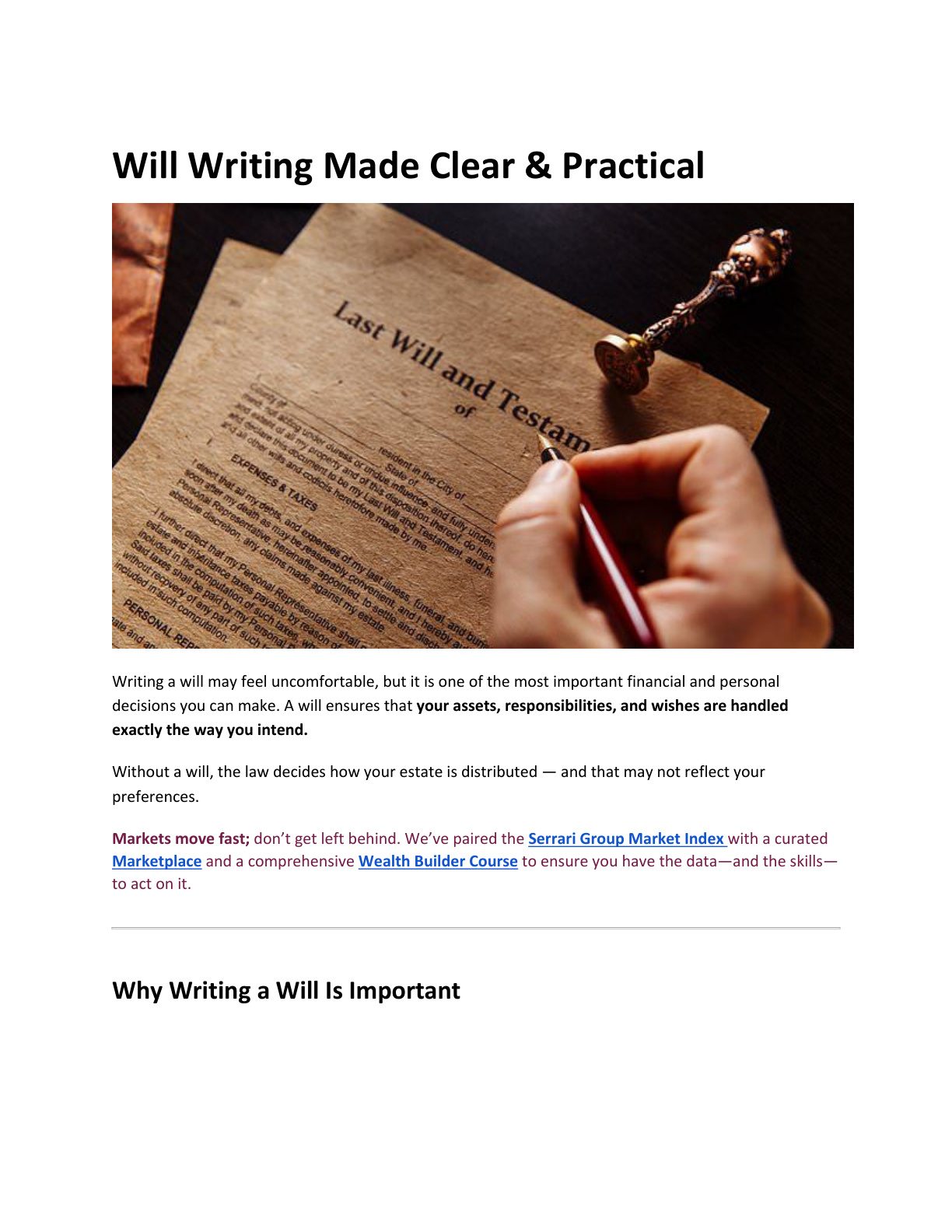
A will ensures your assets are distributed according to your wishes. This step-by-step template guide walks you through every clause of a valid Kenyan will — from appointing an executor to signing and witnessing correctly. Use this as your practical foundation before finalising with a qualified advocate.
What You'll Learn
- Use this template as your practical starting point — then finalise with a Kenyan advocate
- A valid Kenyan will must be signed by the testator and two independent witnesses
- Name your executor clearly and appoint an alternate in case they cannot serve
- Specific bequests must identify assets precisely to prevent disputes
- Appoint a guardian for minor children and consider a testamentary trust
- Grant your executor the powers they need to administer your estate efficiently
- Include a digital assets clause for online accounts and cryptocurrency
- Probate validates the will — a correctly drafted will makes this process faster
How to Use This Will Writing Template

This guide breaks a Last Will and Testament into ten logical steps, each explained with Kenya-specific legal context and followed by the relevant template clause. A will is one of the most important legal documents you will ever create — it determines who inherits your assets, who raises your children, and who manages your estate when you are no longer able to.
Work through each step in order, filling in your specific details as you go. When you have completed a first draft, review the entire document with a qualified advocate registered with the Law Society of Kenya (LSK) before signing. Legal review is not optional — a will with a drafting error, an incorrectly described asset, or an improperly witnessed signature can be invalidated entirely, sending your estate into intestacy.
Two foundational concepts govern estates in Kenya and appear throughout this guide. Probate is the court process by which the High Court of Kenya validates a will and grants the executor legal authority to administer the estate. Letters of Administration are issued when a person dies without a valid will — the court appoints an administrator, and the estate is distributed according to the Law of Succession Act rather than the deceased's wishes.
Read the full will writing guide before using this template | Understand how your will fits into your complete succession plan
Before You Begin: Key Concepts in Kenyan Succession Law
Before drafting your will, understanding three core legal concepts will make every clause more meaningful and every decision more deliberate.
Testamentary capacity: Under Kenya's Law of Succession Act (Cap 160), you must be at least 18 years old (or lawfully married and under 18) and of sound mind to make a valid will. Sound mind means you understand the nature of making a will, the general extent of your assets, who your natural heirs are, and how the document distributes your estate among them. If capacity is later disputed, the court will examine medical records and witness testimony from the time of signing.
Intestacy: If you die without a valid will, your estate is intestate. The Law of Succession Act then distributes your assets according to a fixed statutory formula — typically giving specified shares to your spouse, children, and parents in that order. No weight is given to your verbal wishes, your relationships, or your promises. The formula may produce an outcome you would never have chosen.
Testamentary freedom and protected rights: In Kenya, you have broad freedom to leave your assets to whoever you choose. However, the Law of Succession Act gives certain dependants — particularly a surviving spouse and minor children — protected rights to a portion of the estate regardless of the will. Attempting to disinherit them entirely is legally difficult and subject to court challenge.
Build a complete succession plan to complement your will | See how wealth distribution connects to your financial management strategy
Step 1: Identify Yourself — The Testator Declaration
The opening clause establishes who is making the will and formally declares it to be your Last Will and Testament. It must confirm your legal capacity and revoke all previous wills.
TEMPLATE CLAUSE:
LAST WILL AND TESTAMENT OF [Your Full Legal Name]
I, [Your Full Legal Name], holder of National ID No. [XXXXXXXX] / Passport No. [XXXXXXXX], of [Physical Address, Sub-County, County], Kenya, being of sound and disposing mind, memory, and understanding, hereby declare this to be my Last Will and Testament. I revoke all former wills, codicils, and testamentary dispositions previously made by me.
This document is governed by the Law of Succession Act (Cap 160) of Kenya.
KEY POINTS: Use your full name exactly as it appears on your national ID or passport — this prevents identity challenges later. Include your national ID or passport number for absolute identification. The revocation clause is mandatory — without it, a prior will may be deemed still partially operative, creating conflict between documents.
Understand the full legal requirements for a valid Kenyan will | Build your succession plan before finalising your will
Step 2: Appointing Your Executor
Your executor is your legal representative after death. They are responsible for obtaining probate, collecting assets, settling debts, filing tax returns, and distributing the estate to beneficiaries. This is a demanding role — choose carefully.
TEMPLATE CLAUSE:
APPOINTMENT OF EXECUTOR
I appoint [Executor's Full Legal Name], holder of National ID No. [XXXXXXXX], of [Address], as the Executor of my estate.
If this person is unable or unwilling to serve, I appoint [Alternate Executor's Full Legal Name], holder of National ID No. [XXXXXXXX], of [Address], as alternate Executor.
The Executor shall have full authority to administer and distribute my estate according to this will and applicable Kenyan law, and shall be entitled to reimbursement of all reasonable expenses incurred in administering the estate.
KEY POINTS: Always name an alternate executor — the primary may predecease you, lose capacity, or simply refuse to serve. Consider naming a professional executor (bank trust department or law firm) for complex or high-value estates. Discuss the role with your chosen executor before appointing them — it is a significant time commitment, particularly in Kenya where probate can take twelve months or more.
Read the full executor selection guide in the will writing article | Understand how executor duties relate to your overall succession plan
Step 3: Payment of Debts and Expenses
Before any beneficiary receives a shilling, your estate must satisfy all outstanding obligations. This clause authorises your executor to use estate assets for debt settlement and administration.
TEMPLATE CLAUSE:
PAYMENT OF DEBTS AND EXPENSES
I direct my Executor to pay, as soon as reasonably practicable after my death and from the assets of my estate, all my lawful debts, funeral and burial expenses, and the costs of administering this estate, including probate fees and any professional fees. My Executor shall also settle any outstanding income tax, capital gains tax, stamp duty, and other statutory obligations due to the Kenya Revenue Authority.
KEY POINTS: In Kenya, debts follow the estate — not the beneficiaries. Your executor cannot distribute assets until debts are settled. If debts exceed assets, the estate is insolvent and beneficiaries receive nothing. For this reason, consider life insurance policies sized to cover outstanding liabilities (mortgage, personal loans, business debts personally guaranteed) so that your estate is solvent after your death.
The clause should specify the order in which assets should be used for debt settlement if you have strong preferences — for example, using liquid assets before selling property.
Understand how insurance can protect your estate from debt obligations | See how statutory payments affect estate administration in Kenya
Step 4: Making Specific Gifts and Bequests
Specific gifts are named assets left to named beneficiaries. This is where your personal intentions become legally binding instructions. The golden rule is specificity — vague descriptions are the most common source of will disputes.
TEMPLATE CLAUSE:
SPECIFIC GIFTS
I give, bequeath, and devise the following specific gifts:
(a) My property known as [Property Description], situated at [Physical Address], registered as LR No. [Land Reference Number] in the Land Registry of [County], to [Full Name of Beneficiary], ID No. [XXXXXXXX].
(b) My [Bank Name] [Account Type] Account No. [XXXXXXXXXX] and all funds held therein at the date of my death, to [Full Name of Beneficiary], ID No. [XXXXXXXX].
(c) My [Vehicle Description], Registration No. [KXX XXXX], to [Full Name of Beneficiary], ID No. [XXXXXXXX].
If any specific beneficiary predeceases me, that gift shall lapse and fall into the residuary estate unless I have named an alternate beneficiary for that gift.
KEY POINTS: Never write my house or my car — always provide the legal description, LR number, registration number, or account number. Identify each beneficiary by full name and national ID number. Name alternates for each significant bequest. Do not include assets you do not own at the time of signing — future assets belong in the residuary clause.
Use the companion will writing guide to understand beneficiary selection | Build your estate plan as part of your broader succession strategy
Step 5: The Residuary Estate Clause
The residuary estate is everything not covered by specific bequests — remaining cash, investments, personal property, digital assets with monetary value, and any assets acquired after the will was signed. This clause ensures no asset falls outside your will.
TEMPLATE CLAUSE:
RESIDUARY ESTATE
I give, bequeath, and devise the remainder of my estate (the residuary estate), including all property not specifically disposed of above and all property that I may acquire or become entitled to after the date of this will, to [Full Name(s) of Residuary Beneficiary/Beneficiaries], in equal shares / in the following proportions: [Specify if unequal].
If more than one residuary beneficiary is named and one predeceases me, their share shall pass to the surviving residuary beneficiaries in equal proportions, unless I direct otherwise below.
Alternatively, if [Alternate Residuary Beneficiary] survives me, the deceased beneficiary's share shall pass to them.
KEY POINTS: The residuary clause is essential — without it, assets not mentioned in specific bequests may fall into intestacy, even if you have a valid will. It is also the safety net for assets you acquire after signing your will. If you have significant investment portfolios, money market fund balances, or business interests that change in value and composition over time, the residuary clause captures them all without requiring frequent will amendments.
Understand how investment assets transfer through your estate | Review your estate plan alongside your investment portfolio annually
Step 6: Guardianship of Minor Children
If you have children under 18, this clause is among the most consequential in your entire will. Without it, a court appoints a guardian — and that person may not be who you would have chosen.
TEMPLATE CLAUSE:
GUARDIANSHIP OF MINOR CHILDREN
If any of my children are minors at the time of my death, and if both parents are deceased, I appoint [Guardian's Full Name], ID No. [XXXXXXXX], of [Address], as Guardian of the person and property of my minor children.
If this person is unable or unwilling to serve as Guardian, I appoint [Alternate Guardian's Full Name], ID No. [XXXXXXXX], of [Address], as alternate Guardian.
I request, but do not legally require, that any Guardian appointed under this clause maintain my children in their current school, community, and social environment to the extent possible and practicable.
KEY POINTS: Discuss this appointment with the proposed guardian before including their name — it is a profound responsibility that requires their active consent. Consider practical factors: the guardian's age and health, their relationship with your children, their financial situation, their location, and whether they share your values on education and upbringing. Name an alternate in case the primary cannot serve. The guardian of the person (who raises the children) and the trustee of the children's funds (who manages their inheritance) can be the same person or different people.
Build a complete protection plan for your family through succession planning | Understand how testamentary trusts protect minors financially
Step 7: Testamentary Trust Provisions
A testamentary trust holds a minor or vulnerable beneficiary's inheritance under a named trustee until the beneficiary reaches a specified age. This prevents a young adult from receiving a large sum before they have the maturity to manage it responsibly.
TEMPLATE CLAUSE:
TESTAMENTARY TRUST
If any beneficiary under this will is a minor at the time of my death, or is otherwise unable to manage their own affairs, I direct my Executor to establish a Testamentary Trust for their benefit, to be administered as follows:
Trustee: I appoint [Trustee's Full Name], ID No. [XXXXXXXX], as Trustee, with [Alternate Trustee's Full Name] as alternate.
Term: The Trust shall continue until the beneficiary reaches the age of [25 / 21 / 30 — specify], at which point the remaining trust assets shall be distributed to the beneficiary outright.
Distributions: During the term of the Trust, the Trustee may make distributions from trust income and capital for the beneficiary's education, healthcare, housing, and reasonable living expenses, at the Trustee's sole discretion.
Investment: The Trustee shall have authority to invest trust assets in accordance with the Trustee Act (Cap 167) of Kenya, with a view to preserving and growing the trust fund.
KEY POINTS: The age you specify for final distribution is a critical decision. Many Kenyan parents specify 25 — old enough for financial maturity, young enough to benefit from the inheritance while building a career. Consider the children's personalities and circumstances. A trust does not prevent access to the money — the trustee can distribute for genuine needs throughout the trust period.
Build your full succession and trust strategy | Understand how to protect wealth across generations
Step 8: Executor Powers and Digital Assets
Your executor needs explicit authority to act on your behalf. Without clearly granted powers, they may face legal obstacles when selling property, managing investments, or accessing financial accounts. A digital assets clause is increasingly essential as more Kenyans hold significant value in online accounts, mobile money, and cryptocurrency.
TEMPLATE CLAUSE:
EXECUTOR POWERS
I grant my Executor full authority, in addition to all powers granted by law, to:
(a) Sell, transfer, or otherwise dispose of any real or personal property of the estate, with or without public auction, at such price and on such terms as the Executor deems appropriate;
(b) Manage, invest, and reinvest estate assets in their absolute discretion during the period of administration;
(c) Access, close, or transfer any bank, mobile money, investment, or pension account held in my name;
(d) Take any legal action necessary to protect or recover estate assets;
(e) Engage and compensate professional advisors (advocates, accountants, valuers) from estate funds.
DIGITAL ASSETS
I authorise my Executor to access, manage, transfer, or close my digital assets, including but not limited to: email accounts; social media profiles; online banking and mobile money accounts (M-Pesa, Airtel Money); cryptocurrency wallets; cloud storage (Google Drive, Dropbox, iCloud); and any online business platforms. I direct my Executor to locate my digital asset inventory document, stored at [Location / Password Manager], and to act in accordance with relevant Kenyan law and each service provider's policies.
Understand how executor powers affect estate administration | Integrate your digital asset plan with your succession strategy
Step 9: Governing Law, Revocation, and Severability
Three final operative clauses complete the substantive portion of your will before the signature section.
GOVERNING LAW CLAUSE:
This Last Will and Testament shall be construed and governed in accordance with the Law of Succession Act (Cap 160) of Kenya, and any other applicable Kenyan legislation. The administration of my estate shall be subject to the jurisdiction of the High Court of Kenya.
REVOCATION CLAUSE:
I hereby expressly revoke all former wills, codicils, and testamentary documents of every nature previously made by me. This document constitutes my sole and entire Last Will and Testament.
KEY POINTS ON REVOCATION: This clause is critical if you have made previous wills. Without it, a court may treat your new will and an older document as coexisting, creating confusion and potential conflict between their provisions. Every new will should explicitly revoke all prior documents.
SEVERABILITY CLAUSE:
If any clause or provision of this will is found to be invalid, unenforceable, or contrary to Kenyan law, that clause shall be severed from this will, and the remaining provisions shall continue in full force and effect as if the invalid clause had never been included.
KEY POINTS ON SEVERABILITY: This is a standard protective clause that prevents a single problematic provision from invalidating your entire will. It is particularly important when wills include complex or unusual provisions that might attract court scrutiny.
Understand the complete legal framework for wills in Kenya | Review your succession plan for legal consistency
Step 10: Signing and Witnessing Your Will Correctly
This is the most critical procedural step — and the most common source of fatal error. A will that is incorrectly signed or witnessed is invalid under Kenyan law, regardless of how carefully every other clause was drafted.
TEMPLATE SIGNATURE BLOCK:
IN WITNESS WHEREOF, I, [Your Full Legal Name], have signed this Last Will and Testament on the [Day] day of [Month], [Year], at [Location], Kenya, in the presence of the two witnesses named below, who have signed in my presence and in the presence of each other.
Signed by the Testator: _________________________________
[Your Full Legal Name] [Date]
ATTESTATION CLAUSE:
We declare that [Your Full Legal Name] signed this will in our simultaneous presence, and that we each signed as witnesses in the presence of the testator and of each other, and that to the best of our knowledge the testator was of sound mind and free from any undue influence at the time of signing.
Witness 1:
Signature: _________________________________
Full Legal Name: _________________________________
National ID No.: _________________________________
Address: _________________________________
Date: _________________________________
Witness 2:
Signature: _________________________________
Full Legal Name: _________________________________
National ID No.: _________________________________
Address: _________________________________
Date: _________________________________
KEY REQUIREMENTS: Both witnesses must be physically present simultaneously when you sign. Both must sign in your presence immediately after you sign. Neither witness — nor their spouse — should be a beneficiary under the will. A beneficiary-witness does not invalidate the will but forfeits their inheritance under it. Never sign in stages or send the document around by courier for signatures — all three signatures must happen in one sitting.
Read the complete will writing guide for all legal requirements | Integrate your signed will into your broader succession plan
Understanding Probate and Letters of Administration in Kenya
Once you die, your executor must apply to the High Court of Kenya for a Grant of Probate — the court order confirming the will is valid and authorising the executor to administer the estate. Understanding this process helps your executor and beneficiaries set realistic expectations.
The probate process in Kenya involves: filing the original will and a certified copy with the court; submitting a death certificate; filing an affidavit sworn by the executor confirming the will is the deceased's last will; filing an inventory of all estate assets and their estimated values; publishing a notice to creditors; and attending a court hearing if the grant is contested.
Timeline: Straightforward probate in Kenya typically takes three to six months from filing. Contested probate — where beneficiaries or creditors challenge the will's validity — can take years. A clearly drafted, properly witnessed will dramatically reduces the risk of contest.
Letters of Administration are issued when there is no valid will. The court appoints an administrator (usually the surviving spouse or a child) and issues an authority document equivalent to probate. The estate is then distributed according to the Law of Succession Act's intestacy formula — not according to the deceased's wishes.
Cost: Probate fees in Kenya are calculated on the value of the estate. Professional legal fees for probate vary but should be budgeted at 2-5% of estate value for a straightforward grant. Factor these costs into your estate planning — you can even fund them through a specific life insurance policy payable to the estate.
Understand how your estate plan connects to statutory obligations | Build your succession plan to minimise probate complexity
Key Takeaways
A well-drafted will is among the highest-value legal documents you will ever create. Use this template as your practical starting point — work through each step, understand every clause, fill in your specific details with precision, then finalise with a qualified Kenyan advocate before signing.
The ten steps covered in this guide — testator declaration, executor appointment, debt settlement, specific gifts, residuary estate, guardianship, testamentary trust, executor powers and digital assets, governing law and revocation, and signing with witnesses — represent a complete and legally sound Last Will and Testament framework under Kenya's Law of Succession Act.
The most important disciplines: use your full legal name and national ID number throughout; name both a primary and alternate executor; be specific about every asset and every beneficiary; name a guardian and alternate guardian for minor children; consider a testamentary trust for any inheritance that may pass to minors or young adults; ensure both witnesses are present simultaneously and are not beneficiaries; store the original will with your advocate and tell your executor where it is; and review and update your will after every major life event.
This template, finalised with professional legal advice, gives your family clarity, control, and protection at the moment when they are most vulnerable. That clarity is your final gift to the people you love most.
Read the full will writing advisory guide for deeper guidance | Build your complete succession and estate plan
Frequently Asked Questions
Can I use this template as my final will in Kenya without seeing a lawyer? This template reflects valid Kenyan legal principles, but every estate is unique. Errors in asset descriptions, witness procedures, or specific clause wording can invalidate a will entirely. For any estate involving property, a business, minor children, or significant assets, finalise the document with a qualified advocate registered with the Law Society of Kenya before signing.
How many copies of my signed will should I keep? Keep the original (signed in wet ink) with your estate attorney. You may also lodge a copy with the Registrar of Documents at Milimani Law Courts — this provides a secure independent backup and reduces the risk of the will being challenged as fraudulent or later-dated. Give your executor a copy and tell them exactly where the original is stored.
What is a codicil and when should I use one? A codicil is a formal amendment to an existing will. It must be signed and witnessed in exactly the same way as the original will. Use a codicil for minor changes — updating an address, changing one beneficiary, adjusting a specific bequest. For substantial revisions, it is usually cleaner and safer to revoke the old will entirely and execute a new one.
Does my Kenyan will cover assets held in other countries? Not automatically. Assets in other jurisdictions are subject to that country's succession laws. If you hold significant assets abroad — property in the UK, investment accounts in the US, bank accounts in the UAE — you may need separate wills in each jurisdiction. An international estate planning attorney can advise on the most efficient structure.
What is the difference between an executor and an administrator? An executor is named in a will and acts under a Grant of Probate. An administrator is appointed by the court when there is no valid will and acts under Letters of Administration. Both have similar duties in administering the estate — the difference is their source of authority and the legal process that grants it.
Return to the full will writing guide for complete legal context | Start your complete succession plan today