Insurance Tools & Risk Protection for Every Need
Practical Insurance Advice Tailored to Every Kenyan Life Stage
Not all insurance needs are the same. Whether you own a home, run a business, or are starting a family, this guide walks you through the right insurance tools for your specific life situation — with Kenya-specific context throughout.
What You'll Learn
- Match your insurance to your specific life stage and assets
- Home, health, motor, life, and business insurance serve different needs
- Kenyan options include SHIF, WIBA, and specialised agricultural micro-insurance
- Bundling policies can reduce premiums by 10-25% annually
- Avoid coverage gaps by reviewing policies every 12 months
- Education and travel insurance are often overlooked but critical
Why Insurance Advice Is Different for Everyone

Insurance is personal. A single professional in Nairobi faces entirely different risks than a smallholder farmer in Meru or a business owner in Mombasa. Generic insurance advice — "get covered" — is nearly useless without context. The right starting point is always a personal risk audit: What do I own? What income do I depend on? Who depends on me? What would a catastrophic loss look like for my household?
In Kenya, there are six primary categories of personal insurance: health, motor, life, property, agricultural, and travel. Business owners add a seventh — commercial insurance. Each covers a distinct class of risk, and most individuals need at least three of them operating simultaneously to be genuinely protected.
The Insurance Regulatory Authority (IRA) of Kenya oversees all licensed insurers. Before purchasing any policy, verify your insurer's licence at ira.go.ke — fraudulent insurance is a documented problem in Kenya, particularly for motor and health products sold through informal channels.
For a broader foundation on how insurance fits into your overall financial structure, read Understanding Insurance and The Difference Between Savings, Investments, and Insurance.
Property and Home Insurance in Kenya

For most Kenyans, a home is the single largest financial asset they will ever own. Losing it to fire, flood, or structural collapse without insurance is not merely a housing crisis — it is a generational financial setback. Yet a survey by IRA found that fewer than 8% of homeowners in Kenya hold active property insurance.
Property insurance in Kenya covers two distinct assets: the building structure and its contents. Building insurance protects the physical structure against fire, lightening, explosion, flood, subsidence, and malicious damage. Contents insurance covers furniture, appliances, clothing, and other personal property inside the building. These are often sold separately, and it is a common mistake to insure only the building while leaving KSh 500,000 or more in contents unprotected.
Key considerations for Kenyan homeowners: (1) Undervaluation — many policies are written at 60-70% of actual replacement cost, meaning you receive less than you need to rebuild after a total loss; always insure at full replacement value, not market value. (2) Flood exclusions — properties in flood-prone areas may have flood damage excluded by default; request a flood rider explicitly. (3) Domestic worker liability — WIBA cover for domestic employees is legally required and is often bundled into comprehensive home policies.
For tenants, contents insurance is equally important. At roughly KSh 3,000-8,000 per year for KSh 300,000 of cover, it is one of the best-value insurance products in Kenya.
Use our Net Worth Calculator to tally your home contents and ensure your coverage amount is adequate. Build your emergency cash buffer alongside property insurance using How to Build an Emergency Fund in Kenya.
Health Insurance in Kenya — SHIF, Supplementary and Group Cover

Healthcare costs are one of the top causes of financial ruin for Kenyan families. A single ICU admission can cost KSh 150,000-500,000. Without cover, families liquidate savings, sell assets, or fall into debt spirals from which recovery takes years.
The Social Health Insurance Fund (SHIF, formerly NHIF) is Kenya's national health insurer and the mandatory baseline for formal sector employees. SHIF contributions are income-graduated and provide access to the Linda Mama maternal health programme, inpatient care at public and selected private hospitals, and outpatient services at accredited facilities. Key limitations remain: most private specialist hospitals are not fully covered, dental and optical care require supplementary cover, and annual benefit limits can be quickly exhausted by chronic conditions.
Supplementary private health insurance fills these gaps. Products from AAR, Jubilee, Resolution Health, CIC, and Madison offer higher inpatient annual limits, outpatient cover including doctor consultations and pharmacy, dental and optical riders, last-expense cover, and international evacuation for critical care. Premiums range from KSh 15,000-80,000 per year per adult depending on age, cover level, and provider network.
Group health insurance, offered through employers or SACCOs, is typically 30-50% cheaper than individual cover due to risk pooling. If your employer offers group cover, maximise its benefits before purchasing supplementary individual policies.
Critical illness cover pays a lump sum upon diagnosis of listed conditions such as cancer, stroke, heart attack, and kidney failure. Given the rising incidence of these conditions in Kenya, it merits serious consideration alongside your standard health policy.
For more on building the savings buffer that complements health insurance, see How to Build an Emergency Fund in Kenya. Review the full insurance landscape at Understanding Insurance.
Motor Insurance — Beyond the Minimum Legal Requirement

Third-Party Only (TPO) motor insurance is the legal minimum in Kenya under the Traffic Act Cap.403. It covers injury or death to third parties and damage to their property — but provides zero cover for your own vehicle, your own injuries, or theft. Most Kenyans stop here, which is a serious financial vulnerability for anyone whose vehicle is a major asset or income source.
Comprehensive motor insurance adds your own vehicle damage from accident, fire, theft, and flood, along with personal accident cover for the driver and windscreen cover. The premium for comprehensive cover typically runs 3-6% of the vehicle's agreed value per year. For a vehicle worth KSh 1.5M, that is KSh 45,000-90,000 annually — a worthwhile expense given that vehicle theft losses in Kenya regularly exceed KSh 1M.
Key concepts before signing: (1) Agreed Value vs Market Value — agreed value policies pay the pre-agreed amount regardless of depreciation, while market value policies pay whatever the car is worth at claim time (which may be substantially less). Always negotiate agreed value. (2) Excess or Deductible — the amount you pay out of pocket on each claim; higher excess means lower premium but more exposure per incident. (3) No-Claims Discount — up to 30% premium reduction for claim-free years; protect this discount by not claiming for small damages. (4) PSV and commercial vehicle cover is a separate, higher-rated class — misclassifying a vehicle is grounds for claim denial.
For boda boda operators, matatu owners, and ride-share drivers, PSV cover is mandatory and should include passenger liability and excess of loss cover.
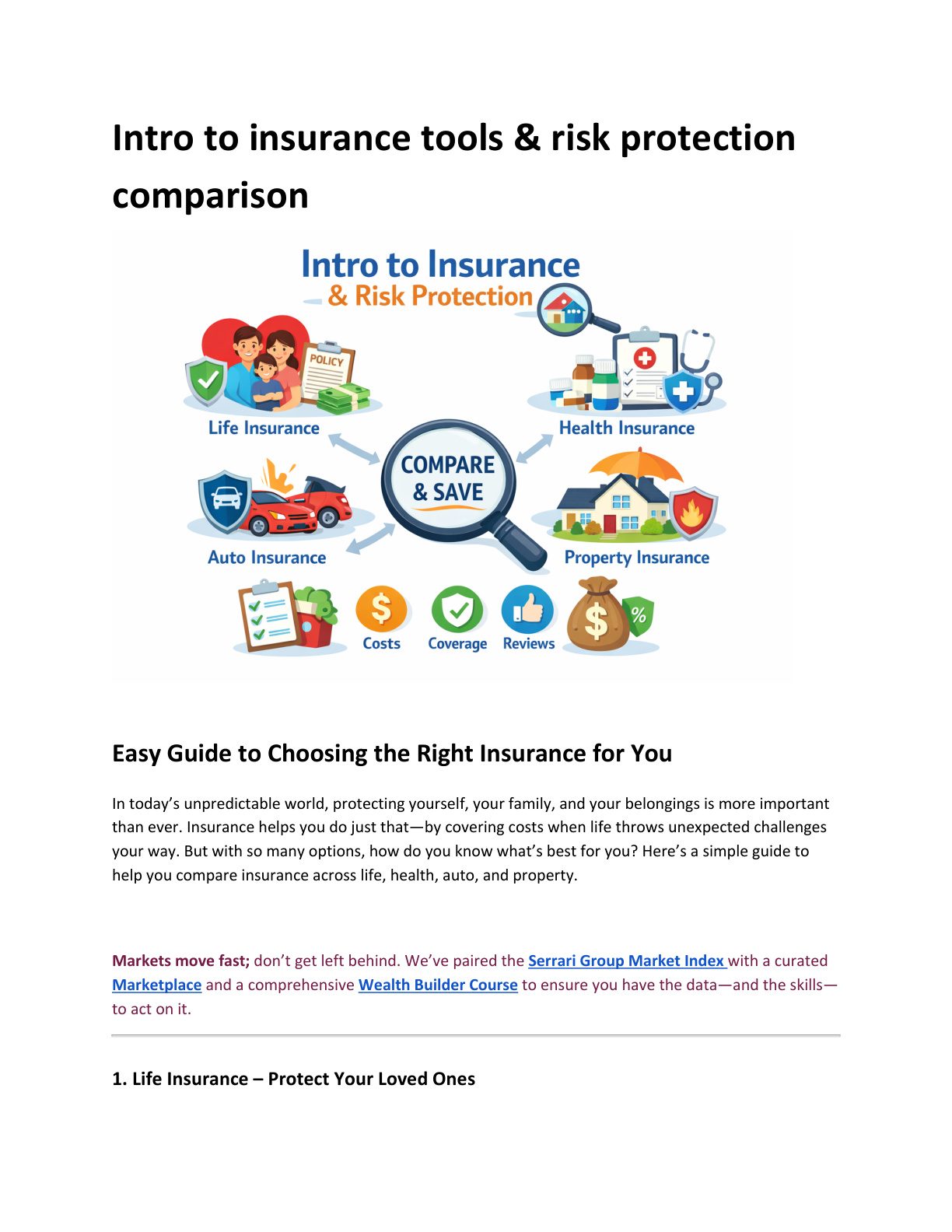
See also Intro to Insurance Tools and Risk Protection Comparison for a side-by-side view of how motor insurance compares to other risk products. For the full claims walkthrough see Understanding Insurance.
Life Insurance — Protecting Your Family's Financial Future

Life insurance solves a specific problem: what happens to the people who depend on your income if you die? In Kenya, where extended family financial obligations run deep and formal social safety nets are limited, life insurance is not optional for anyone with dependants.
Term life insurance is the purest and cheapest form: you pay premiums for a defined period of 5, 10, or 20 years, and if you die within that term, your beneficiaries receive the sum assured. A KSh 5M, 20-year term policy for a healthy 30-year-old costs roughly KSh 10,000-20,000 per year — strikingly affordable given the cover provided. If you survive the term, the policy ends with no payout, but the financial protection it provided during your peak earning and family-building years was the entire point.
Whole life insurance covers you for your entire life and includes a savings component that accumulates over time. Premiums are 5-10 times higher than term, but the policy never expires, premiums remain level, and the cash value can be borrowed against. This is better suited for estate planning and wealth transfer goals than pure income protection.
Investment-linked insurance plans (ILIPs) combine a death benefit with exposure to equity or bond markets. Returns are market-linked and not guaranteed. Before committing, carefully review the fund management charge, administration fee, and surrender penalties — fees in ILIPs are significant and compound over time.
Sizing your life insurance: a widely used rule is 10-12 times your annual gross income. For a Kenyan earning KSh 150,000 per month, that implies KSh 18M-21.6M of cover — a sum that, invested conservatively, would replace your income for over a decade.
To understand how life insurance fits alongside savings tools, read Understanding Savings and apply The 50/30/20 Rule in Kenya to budget your life insurance premiums.
Business Insurance — Safeguarding Your Enterprise

For the 7.4 million Kenyans running small and medium enterprises (SMEs), business interruption is a silent killer. A fire, flood, lawsuit, or employee injury that halts operations for even 60 days can permanently close a business that was otherwise profitable.
Fire and perils cover for business premises protects the physical structure and its contents — stock, equipment, and machinery — against fire, lightening, explosion, flood, and malicious damage. Business interruption (BI) cover is the critical add-on most SME owners overlook: it pays your fixed costs including rent, salaries, and loan repayments during the period your business cannot operate after an insured event.
Public liability insurance covers third-party bodily injury or property damage that occurs on your business premises or as a result of your operations. If a customer slips in your shop, a client's property is damaged during a service call, or a product you sold causes harm, public liability pays the legal and compensation costs.
WIBA cover is a legal requirement for all Kenyan employers regardless of business size. It covers employee medical expenses and compensation for work-related injuries, disabilities, and deaths. The penalty for non-compliance is significant, and WIBA claims can run into millions for serious injuries.
Professional indemnity (PI) insurance is essential for consultants, accountants, architects, engineers, lawyers, and any professional whose advice or services could lead to client losses. PI policies cover legal defence costs and damages from claims of negligence, errors, or omissions.
Use our Net Worth Calculator to tally your business assets and ensure adequate cover. For the broader insurance framework that underpins business protection, revisit Understanding Insurance.
Education Insurance — Securing Your Children's Future
Education insurance is one of Kenya's most emotionally resonant financial products — and one of the most structurally misunderstood. Parents purchase it to guarantee their children's school fees continue regardless of what happens to household income. The mechanism: you pay premiums for a defined period, and the policy pays out a lump sum or periodic instalments timed to coincide with school fee payment dates.
Two variants dominate the Kenyan market. Education endowment plans are savings-plus-insurance hybrids: your premiums accumulate with guaranteed returns of typically 4-7% per year, and the policy also carries a life cover element so the full maturity benefit is paid even if the parent dies midway through. Education term plans are cheaper and purer — they pay only if the parent dies, with no savings accumulation.
Evaluating an education policy requires comparing the internal rate of return (IRR) — the actual annualised return after fees — against alternatives like Money Market Funds (currently 10-14% in Kenya) or a Unit Trust Savings Plan. Many education endowment plans offer IRRs of just 3-5% after charges, which compares poorly to these alternatives. The insurance wrapper does add value, but only if the premium loading is not excessive.
What to look for: a reputable, IRA-licensed insurer with a strong claims-payment record; a clearly defined maturity schedule aligned to your child's school progression; waiver of premium benefit (premiums are waived if you die or become permanently disabled); and surrender values that are not catastrophically low in the first five years.
See how education savings goals work with the Savings Goal Tool and plan alongside your insurance strategy. Build the foundation for education funding using Understanding Savings.
Travel Insurance — Don't Leave Kenya Without It
Travel insurance is treated as an afterthought by most Kenyan travellers — until they need it. Medical evacuation from a safari accident in the Masai Mara to Nairobi Aga Khan Hospital can cost KSh 300,000-800,000. A medical emergency in Europe or North America without insurance can easily run $50,000-$200,000 and result in lifetime debt. Trip cancellation for a KSh 180,000 international flight is a real financial loss. Travel insurance addresses all of these scenarios.
Comprehensive travel insurance covers: emergency medical treatment and hospitalisation abroad, medical evacuation and repatriation, trip cancellation or interruption due to illness or travel disruption, lost or delayed baggage (typically KSh 30,000-150,000 per claim), personal liability abroad, and emergency cash advance.
For Kenyans travelling within East Africa, single-trip policies from CIC, AAR, and Jubilee start at KSh 2,000-5,000 per trip. For frequent international travellers, annual multi-trip policies at KSh 15,000-40,000 per year offer better value than purchasing per trip.
Schengen visa applications require minimum travel insurance of EUR 30,000 medical cover. Many Kenyan travellers purchase the minimum for visa purposes — ensure yours is genuinely comprehensive and not simply compliance paperwork.
A note on pre-existing conditions: most travel insurance policies exclude treatment related to known pre-existing medical conditions. If you have a chronic condition, specifically request a policy that covers it, often at higher premium. Failing to disclose pre-existing conditions is the single most common ground for claim denial.
Build the emergency buffer that supports your travel planning with our Emergency Fund Guide. Budget your travel insurance premiums using The 50/30/20 Rule in Kenya.
Agricultural and Micro-Insurance — Protecting Kenya's Farmers
Agriculture employs over 40% of Kenya's workforce and contributes 33% of GDP. Yet agricultural insurance penetration is below 1%. Smallholder farmers — who produce 75% of Kenya's food output — operate without any financial safety net against the weather events, pests, and price collapses that regularly devastate harvests.
Index-based weather insurance (IBWI) is the dominant agricultural insurance product in Kenya. Rather than assessing individual farm losses, IBWI pays out when a rainfall index falls below or above a defined trigger level at the nearest weather station. Products from UAP Old Mutual, APA Insurance, and the Kenya Crop Insurance Programme cover maize, sorghum, sunflower, and tea. Premiums start at KSh 500-2,000 per acre per season.
Livestock insurance covers cattle, sheep, goats, and camels against drought, disease, and accident. The Index-Based Livestock Insurance (IBLI) programme in northern Kenya has been a globally recognised model for pastoralist risk management, paying out based on satellite-measured vegetation indices.
The government's Agricultural Insurance Scheme provides premium subsidies to smallholder farmers — eligible farmers can access cover at 50-80% reduced premium through agricultural officers at the county level or through partnering SACCOs.
Micro-insurance products targeting urban and peri-urban low-income earners are expanding. M-PESA's Okoa Jirani hospital cash product and Jubilee's Afya Bima Mkononi offer hospital cash benefits starting at KSh 100 per month, making insurance accessible for the first time to Kenya's informal sector.
For broader risk management principles, see Intro to Insurance Tools and Risk Protection. Connect your agricultural safety net to Understanding Insurance for the full coverage framework.
How to Match Insurance to Your Life Stage
Insurance needs evolve dramatically through life. Purchasing the wrong insurance at the wrong life stage means paying premiums for cover you do not need while leaving critical gaps unaddressed.
In your 20s and single with no dependants, your priority is health and motor insurance plus a modest personal accident policy. Life insurance at this stage is premature unless you have significant loan obligations or financially dependent parents. Use the money saved on life premiums to build your emergency fund — ideally 3-6 months of expenses in a liquid Money Market Fund.
In your late 20s to mid-30s, married with young children, life insurance becomes urgent. Purchase substantial term life cover at 10-15 times your income immediately. Add a comprehensive health plan covering your growing family. If you own a vehicle, upgrade to comprehensive motor cover. Education insurance becomes relevant as you plan for school fees 5-10 years out.
In your 40s, your mortgage (if you have one) should carry mortgage protection insurance — a form of decreasing term life — so the property is fully paid if you die. Review your life cover and increase it as your income and family obligations have likely grown. Critical illness and income protection insurance deserve serious attention as health risks begin escalating.
At 50 and above, the focus shifts from income replacement to asset protection and estate planning. Whole life or universal life policies that build cash value and support wealth transfer become relevant. Long-term disability and critical illness cover remain critical. Begin reviewing whether your life insurance sum assured reflects current wealth, not just income replacement.
At each stage, run your numbers through the Net Worth Calculator and Savings Goal Tool to ensure your insurance strategy aligns with your financial position.
Bundling Strategies — Getting More Coverage for Less
Insurance bundling — purchasing multiple insurance products from the same insurer — is one of the most effective and underused cost-reduction strategies available to Kenyan consumers. Bundling discounts of 10-25% are standard across the major insurers, and bundling also simplifies administration: one renewal date, one insurer relationship, one claims process.
The most common and rewarding bundle in Kenya is the home-and-motor package. Combining property insurance with comprehensive motor cover from the same insurer typically yields a 10-15% discount on the combined premium. A household spending KSh 45,000 per year on motor cover and KSh 12,000 on home insurance could save KSh 5,700-14,250 annually through bundling.
Health-and-life bundles are the second major category. Many Kenyan insurers offer family packages that combine group health insurance with term life cover at a combined premium meaningfully lower than purchasing separately. Some include personal accident as a free rider.
Business insurance is almost always more cost-effective as a package policy — combining fire and perils, business interruption, public liability, and WIBA into a single combined commercial policy rather than sourcing them individually. Insurers offer these packages to SMEs at 15-25% below the sum of individual covers.
Important limitations: bundled policies are convenient but can create lock-in. Before auto-renewing a bundle, compare with the market every 2-3 years. Also check that bundling has not compressed coverage — some bundled products have lower sublimits or wider exclusions than standalone policies in the same category.
Read The 50/30/20 Rule in Kenya to see how to budget your insurance premiums within your monthly income. For a structured view of all insurance types, see Intro to Insurance Tools and Risk Protection Comparison.
How to Avoid Under-Insurance and Coverage Gaps
Under-insurance is the single most expensive insurance mistake Kenyans make, and it is rampant. The IRA estimates that 60% of insured property in Kenya is under-insured — meaning policyholders receive partial payouts proportional to their declared value, not the full replacement cost. This principle — called "average" or "co-insurance" — means that if your home is worth KSh 12M and you insure it for KSh 7M, you bear 41.7% of every loss yourself, even after the excess is applied.
How to avoid under-insurance: (1) Insure at full replacement value, not market value. Replacement value is the cost to rebuild from scratch at today's construction rates — in Nairobi this is approximately KSh 55,000-85,000 per square metre. (2) Review and adjust sums assured annually. Construction costs in Kenya have risen approximately 12-18% since 2020. A policy written in 2020 at accurate values is almost certainly under-insured today. (3) For motor vehicles, use agreed value rather than market value to eliminate depreciation disputes at claim time.
Coverage gaps — risks that exist but are not covered by any policy — are equally dangerous. Common gaps among Kenyan middle-income households include: no disability or income protection cover (disability can be more financially devastating than death for dependants), no personal liability cover outside of motor, no coverage for jewellery and high-value items (typically excluded from standard contents cover above KSh 50,000 per item), and no cover for home-based business activities (most home policies exclude business use).
Annual policy reviews catch these gaps before they become crises. Schedule a 30-minute annual review with your insurance broker at the same time each year.
Use our Net Worth Calculator annually to track asset values and flag insurance gaps proactively. Understanding the broader financial picture is essential — see The Difference Between Savings, Investments, and Insurance.
Switching, Comparing and Reviewing Your Policies
The Kenyan insurance market is competitive, and policyholder inertia is expensive. IRA data shows that a Kenyan who shops their motor insurance annually saves an average of KSh 8,000-18,000 per year versus auto-renewing with the same insurer. Over a decade, that is KSh 80,000-180,000 in avoidable premium expenditure.
How to compare policies effectively: (1) Standardise the comparison — ensure you are comparing identical sums assured, excess levels, and cover categories. A policy that is KSh 5,000 cheaper but excludes flood damage or windscreen cover is not a genuine saving. (2) Check claims payment rates — IRA publishes annual industry statistics including complaints data and claims settlement ratios by insurer. Choose insurers with settlement ratios above 80% and low complaints volumes. (3) Use a licensed broker or aggregator — platforms like Bismart, Pesapal Insurance, and comparison tools from major insurers allow you to compare multiple quotes side by side without committing to a purchase.
Switching procedures in Kenya: mid-term cancellations are generally penalised (refund calculated on a short-rate basis, which is less than pro-rata). The ideal time to switch is at policy renewal. Obtain your new policy confirmation before cancelling the existing one to avoid any gap in cover.
When to review, not just renew: any major life change — marriage, divorce, birth of a child, home purchase, business launch, or significant salary change — should trigger an immediate insurance review. These events create new risks and assets that existing policies may not address.
For a comprehensive view of how insurance fits into your broader risk management, revisit Understanding Insurance. Use Intro to Insurance Tools and Risk Protection Comparison to benchmark your current cover against all available options.
Key Takeaways
Insurance is not one-size-fits-all. Your home, your health, your vehicle, your family, and your business each carry distinct risks that require purpose-built products. The most common and costly insurance mistake is purchasing the cheapest available cover and assuming the problem is solved.
In Kenya, the foundational insurance stack for a household with dependants includes: comprehensive health cover (supplementary to SHIF), term life insurance at 10-15 times your income, comprehensive motor cover if you own a vehicle, and property insurance if you own or rent a home. Beyond this baseline, education insurance, travel cover, business insurance, and agricultural micro-insurance extend protection to specific life situations.
Premium cost is a frequent barrier, but insurance is not all-or-nothing. Prioritise the risks with catastrophic loss potential first — health emergencies and premature death — before optimising for convenience cover. Use bundling, annual reviews, and market comparison to keep premiums competitive without sacrificing essential cover.
Coverage gaps and under-insurance are silent risks that only reveal themselves at claim time, when it is too late to fix them. Build a habit of annual policy reviews, keep sums assured current with asset values, and document all your policies in one accessible location for your family.
Your insurance strategy should be reviewed alongside your broader financial plan. Connect it to your emergency fund, savings goals, and investment portfolio to ensure all elements work together. How to Build an Emergency Fund in Kenya and The 50/30/20 Rule in Kenya are essential reading for building that complete financial foundation.
Frequently Asked Questions
Can I hold insurance with multiple insurers simultaneously? Yes, and in many cases you should. It is common and entirely legal to hold motor cover from one insurer, health from another, and life from a third. The key rule is that you cannot profit from insurance: if you hold two health policies, you can claim actual costs from each but cannot receive more than your actual medical expenses in total.
Is SHIF sufficient as my only health cover? For many routine outpatient needs, SHIF provides adequate access at accredited public facilities. However, SHIF's annual limits and the restricted private hospital network make it insufficient as the sole cover for anyone who may require specialist care, elective procedures, or treatment at private hospitals. Supplementary private cover is strongly recommended for middle-income earners and above.
How do I check if my insurer is licensed? Visit ira.go.ke and use the licensed insurers directory. Purchasing from an unlicensed insurer provides no legal protection and claims are unenforceable. This is particularly important for motor cover sold through informal channels or WhatsApp groups.
What happens to my insurance when I change jobs? Employer-provided group health and life cover ceases when you leave. Before your final day, either convert the group policy to an individual one — most insurers allow this without new medical underwriting — or arrange independent cover to avoid a gap. Leaving without replacement cover, even for 30 days, risks an unprotected period.
What is the difference between a broker and a direct insurer? A broker represents you — they work across multiple insurers to find the best cover for your specific needs. A direct insurer sells only their own products. For complex needs such as business, health, or combined personal lines, a licensed broker typically adds more value than going direct. Brokers in Kenya are regulated and licensed by IRA.
How do I ensure my insurance claim is paid? Document everything before it happens: photograph your home contents, keep vehicle records, and maintain medical records. At claim time: notify your insurer within 24-48 hours (most policies have strict reporting windows), complete all required claim forms accurately, and follow up in writing. Most legitimate claim delays in Kenya arise from incomplete documentation, not insurer bad faith. Revisit our Insurance Comparison Guide and explore all your coverage options at Understanding Insurance.