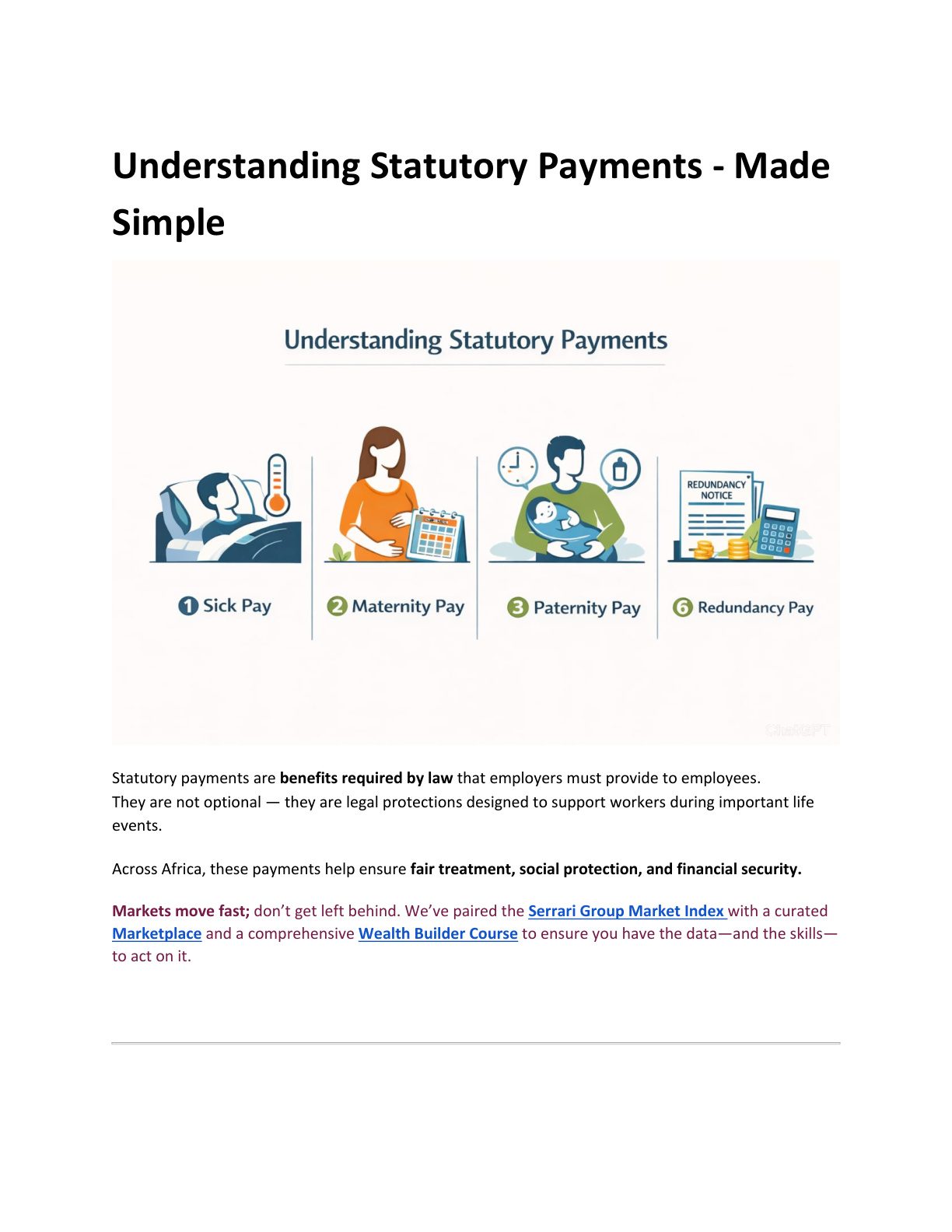
Benefits of Critical Statutory Payments in Kenya
Understanding SHIF, NSSF & PAYE — Beyond Just Deductions
In Kenya, statutory payments like SHIF, NSSF, and PAYE are more than legal requirements. They form the foundation of social protection and economic stability for every formally employed Kenyan. This guide explores the tangible benefits each payment provides to employees, employers, and Kenya as a whole.
What You'll Learn
- SHIF provides broad health coverage — outpatient, inpatient, maternity, chronic care
- SHIF eliminates large out-of-pocket medical costs for covered conditions
- NSSF builds your retirement savings with every payslip — compounding over decades
- NSSF pays disability and death benefits to protect your dependants
- PAYE funds the public infrastructure and services every Kenyan uses daily
- The Housing Levy funds affordable housing access for contributing members
- Statutory compliance makes employers more trusted, stable, and competitive
- Combined, these payments create a comprehensive financial safety net for workers
Why Statutory Payments Are More Than Just Deductions

Most employees experience statutory deductions as a monthly reduction in take-home pay — an involuntary transaction between their gross salary and the net amount in their account. This framing is both accurate and deeply incomplete. Every statutory deduction is simultaneously an investment: in your retirement, your healthcare, your workplace protection, and the national infrastructure your daily life depends on.
In Kenya, the statutory payment framework is more comprehensive than most employees realise. SHIF pools your health risk with millions of other Kenyans, giving you collective access to healthcare you could not afford individually. NSSF compounds your retirement savings over decades. PAYE funds the public hospitals, roads, schools, and security services that sustain daily life. The Housing Levy funds affordable property access. WIBA insurance protects your income and your family against workplace catastrophe.
Reframing statutory payments as investments rather than taxes changes your relationship with them entirely. You are not losing money to deductions — you are building a financial safety net, contributing to national infrastructure, and securing your future with every payslip.
Get the full compliance detail on each statutory payment | Understand how statutory benefits integrate into your wealth plan
SHIF: How Kenya's Health Insurance Protects You
The Social Health Insurance Fund (SHIF), administered by the Social Health Authority (SHA), is Kenya's national public health insurance scheme established under the Social Health Insurance Act 2023. It replaced the National Hospital Insurance Fund (NHIF) and was designed to expand coverage, increase accessibility, and move Kenya closer to Universal Health Coverage (UHC).
The fundamental benefit SHIF provides is protection against financial catastrophe from medical events. Healthcare costs in Kenya — particularly for inpatient care, specialist treatment, cancer, and chronic disease management — can easily exceed annual salary levels for middle-income workers. Without insurance, a single serious illness can erase years of savings, force asset sales, or leave families in debt for years.
SHIF contributions are 2.75% of gross salary with no upper cap. In exchange, the fund covers you and your registered dependants for a broad range of health services at accredited facilities across Kenya. The protection is immediate — there is no waiting period for coverage once you are registered and your employer is remitting. For salaried Kenyans, this is among the most cost-effective forms of health protection available.
Understand all your statutory obligations and their verification | See how health insurance fits into your complete financial protection plan
SHIF Benefits in Detail: What You Can Access
SHIF provides a comprehensive package of covered health services that significantly exceeds what the old NHIF provided. Understanding the full scope helps you utilise your coverage effectively and recognise when to seek care without financial hesitation.
Outpatient services cover consultations with general practitioners and specialists, diagnostic tests (blood work, imaging, urinalysis), treatment at registered outpatient facilities, physiotherapy, and preventive care including vaccinations. Inpatient services cover hospitalisation at accredited public and private facilities, surgical procedures, intensive care, and post-operative care. Chronic and specialised care extends to cancer treatment (chemotherapy, radiotherapy), renal dialysis, cardiac care, mental health services, and long-term disease management for conditions like diabetes and hypertension.
Maternity and child health services include antenatal consultations and tests, delivery at accredited facilities, postnatal care, and newborn care. This coverage is particularly valuable given the high cost of private maternity services in Kenya. Screening and diagnostic services — imaging including X-rays, CT scans and MRI, laboratory tests, and specialist diagnostic procedures — are covered at accredited facilities. Rehabilitation services and assistive devices are covered for qualifying conditions, including physiotherapy, occupational therapy, and assistive equipment.
Verify your SHIF coverage status and contribution history | Build a comprehensive financial protection plan that complements SHIF
SHIF and Universal Health Coverage in Kenya
SHIF is Kenya's primary structural mechanism for achieving Universal Health Coverage — the goal that every citizen can access quality healthcare services without suffering financial hardship. Kenya has committed to UHC as both a Constitutional obligation (Article 43 guarantees the right to the highest attainable standard of health) and a development priority.
The fund achieves UHC through risk pooling: by combining contributions from millions of workers into a single national fund, SHIF creates the financial base to cover catastrophic medical costs for any individual member. No single contributor could self-insure against the cost of, say, a cancer diagnosis or a multi-week ICU admission — but the collective fund can absorb these costs because they are spread across the entire contributor base.
SHIF also covers the informal sector through voluntary registration, allowing Kenyans outside formal employment to access the same coverage by contributing a minimum of KES 300 per month. This design — bringing both formal and informal sector workers into a single national pool — is what gives SHIF its UHC ambition. As a formal-sector contributor, your SHIF membership connects you to this national solidarity framework while ensuring your own household has comprehensive health cover.
See how statutory payments create a nationwide social safety net | Build your personal health and financial protection strategy
NSSF: Building Your Retirement Security
The National Social Security Fund is mandatory retirement savings delivered through the most powerful mechanism available: automatic payroll deduction. This structure ensures you save for retirement consistently, regardless of competing financial pressures in any given month. The discipline that most people fail to maintain voluntarily is built into the system — and it compounds over decades.
Consider the mathematics: an employee contributing 6% of a KES 80,000 salary from age 25, matched by their employer, accumulates KES 9,600 per month in combined contributions. Over 35 years, assuming the fund generates even a modest real return, this produces a substantial retirement nest egg. The compounding effect — returns earning returns — is what transforms modest monthly contributions into meaningful retirement capital.
NSSF contributions are also tax-efficient: your employee contribution (up to certain limits) qualifies for pension relief, reducing your PAYE liability. This means your net cost of NSSF contribution is lower than the gross deduction on your payslip — the tax system effectively subsidises your retirement savings. For maximum benefit, supplement NSSF with contributions to a registered private pension scheme, which provides additional tax relief and typically offers better investment options than the mandatory NSSF Tier I account.
Integrate NSSF into your complete retirement and wealth plan | Understand how NSSF fits alongside other savings instruments
NSSF Disability and Survivors Benefits
NSSF does not only serve retirees. It provides critical financial protection across two additional scenarios that affect many Kenyan workers before they reach retirement age: permanent incapacity and death.
Disability benefit: If you become permanently incapacitated and cannot work, NSSF pays a disability benefit based on your accumulated contributions and membership period. This benefit is activated by a medical assessment confirming permanent incapacity. It provides income replacement for a worker whose earning capacity has been permanently destroyed by illness or injury — complementing (not replacing) private disability insurance, which should also form part of your protection strategy.
Survivors benefit: If you die while an active NSSF member, your nominated beneficiaries receive a survivors benefit. This is why nominating your beneficiaries on your NSSF account is not optional — without a nomination, payment may be delayed by succession proceedings. Log into nssf.or.ke and verify that your current beneficiary nominations are up to date, particularly after marriage, divorce, birth of a child, or death of a previously nominated beneficiary.
The combination of retirement, disability, and death benefits makes NSSF a multi-dimensional protection instrument — not simply a retirement savings account. Understanding all three dimensions helps you evaluate how NSSF fits into your complete financial protection and estate planning strategy.
Integrate NSSF survivors benefits into your succession planning | Build a complete financial plan that accounts for all risk scenarios
PAYE: How Your Tax Builds Kenya's Future
PAYE is often framed purely as a deduction — the government taking money from your salary. The more complete framing is that PAYE is your proportional contribution to the collective infrastructure that makes modern Kenyan life possible.
PAYE revenue funds public hospitals and dispensaries where millions of Kenyans receive care. It funds public primary schools, secondary schools, and universities that provide education from primary through to professional qualification. It funds national roads, bridges, and transport infrastructure. It funds the police service, judiciary, and prison system that maintain public order and administer justice. It funds public health programmes — vaccination campaigns, disease surveillance, and emergency response systems. And it funds the regulatory agencies — the CMA, NSSF, SHA, KRA itself — that protect your financial and employment rights.
Without PAYE, none of these services exist at the scale Kenya requires. The progressive structure of Kenya's PAYE system — where higher earners pay higher marginal rates — means that the tax system redistributes income and funds services that disproportionately benefit lower-income Kenyans. As a PAYE contributor, you are participating in this national solidarity framework, not merely complying with a legal obligation.
Understand your full statutory obligations and how to manage them | Integrate tax planning into your personal financial strategy
PAYE Benefits: Progressive Fairness and Simplified Compliance
Beyond funding public services, Kenya's PAYE system provides two direct benefits to employees: progressive tax fairness and administrative simplicity.
Progressive fairness: The PAYE band structure ensures that lower earners pay lower effective rates than higher earners. The personal relief of KES 2,400 per month effectively exempts a portion of every employee's income regardless of salary level — providing proportionally greater relief to lower earners. Additional reliefs — pension contributions, registered insurance premiums, and mortgage interest — reward financially responsible behaviour by reducing taxable income. The structure is designed so that someone earning KES 30,000 per month pays a much lower effective tax rate than someone earning KES 300,000 per month.
Simplified compliance: Unlike self-employed Kenyans who must calculate, file, and pay their own income tax quarterly and annually, employed Kenyans have their tax managed entirely by their employer. The employer calculates PAYE on each salary payment, deducts the correct amount, and remits it to KRA by the 9th of the following month. For the employee, tax compliance is automatic. Your only obligations are to ensure your employer has accurate information about your allowable deductions, file your annual income tax return by 30th June (to confirm no overpayment or underpayment), and register on iTax at kra.go.ke to monitor your own tax profile.
Get the full breakdown of PAYE calculation and compliance | Incorporate tax efficiency into your wealth management strategy
Housing Levy: Building a Home-Owning Kenya
The Affordable Housing Levy, introduced in 2023, requires both employer and employee to contribute 1.5% each of gross salary monthly (3% combined) to the National Housing Corporation's Affordable Housing Fund. This levy represents a new dimension of Kenya's statutory framework — one directed specifically at addressing the housing affordability crisis that affects the majority of formally employed Kenyans.
The benefit to contributors: priority access to affordable housing units developed under the Affordable Housing Programme at subsidised prices, made possible by the pooled fund. For most salaried Kenyans in urban areas, purchasing property at market prices requires either high income, a large inheritance, or decades of saving. The Affordable Housing Programme creates a structured pathway to homeownership at below-market prices for registered contributors.
Housing is typically a family's largest single financial asset. Owning property provides inflation protection (real assets appreciate with inflation rather than being eroded by it), eliminates rental costs in retirement, and creates an asset that can be inherited. For Kenyan workers who have consistently struggled to enter the property market at market prices, the Affordable Housing Programme — funded through the levy — represents a meaningful structural opportunity. Monitor the National Housing Corporation at nhc.go.ke for current programme details and application processes.
Incorporate property ownership into your wealth management plan | Understand all statutory deductions that appear on your payslip
Employee Compensation Fund: Your Workplace Safety Net
The Work Injury Benefits Act (WIBA) mandates that every employer insure their workers against occupational injury, disease, and death. This employer-funded insurance — the Employee Compensation Fund — provides financial protection against one of the most financially devastating events that can affect a working Kenyan: a serious workplace injury.
The benefit to employees is direct and comprehensive: medical treatment and rehabilitation costs are covered from the point of injury, regardless of your employer's financial position (because it is insured, not self-funded); temporary incapacity benefit replaces a portion of your salary while you are unable to work due to a covered injury; permanent incapacity compensation provides a lump sum if the injury causes lasting disability, calculated according to the WIBA Schedule of Impairment; and death benefits are paid to your nominated dependants if a workplace accident or occupational disease is fatal.
This protection operates independently of your personal insurance coverage and independently of your employer's goodwill. An uninsured employer who injures an employee faces criminal prosecution — but the criminal consequence does not pay your medical bills. For this reason, verifying that your employer maintains WIBA cover is part of your employment due diligence. You can verify with DOSH at dosh.go.ke. If you are injured at work, report immediately, document everything, and seek care at a WIBA-registered facility to ensure your claim is valid.
Understand how WIBA complements your personal insurance protection | Know your full rights under Kenya's statutory framework
Combined Benefits for Employees: The Full Picture
When Kenya's statutory payment framework is viewed as a complete system rather than a list of separate deductions, its value becomes clear. Together, the payments address every major category of financial risk facing a Kenyan worker.
Health risk: covered by SHIF — your contributions pool your risk with millions of others, ensuring access to healthcare without financial catastrophe. Retirement risk: covered by NSSF — mandatory savings compounding over decades, providing income after employment ends. Income tax obligation: managed by PAYE — automatically calculated and remitted, with progressive structure and multiple reliefs available. Housing affordability: addressed by the Housing Levy — pooled contributions funding subsidised property access for contributors. Workplace injury risk: covered by WIBA — employer-funded insurance providing medical, incapacity, and death benefits without asset liquidation.
The combined effect is a financial safety net that no individual could construct through private means at the same cost. Group risk pooling — across millions of contributors — makes SHIF, NSSF, and WIBA dramatically more cost-effective per unit of coverage than individual insurance or individual savings. This is the economic logic of mandatory social insurance: it works precisely because everyone participates, which means the risk pool is large enough to absorb catastrophic individual events without financial collapse.
See the full compliance framework behind these benefits | Build your personal financial plan on top of your statutory foundation
Benefits for Employers: Why Compliance Pays
Statutory compliance is not only an obligation for employers — it is a business investment with measurable returns across multiple dimensions. Understanding why compliance pays helps employers move beyond viewing statutory payments as costs and toward viewing them as components of a productive employment relationship.
Legal protection: Non-compliance with NSSF, SHIF, PAYE, Housing Levy, and WIBA exposes company directors and officers to criminal prosecution, fines, interest on arrears, and reputational damage. The cost of compliance — consistent and on-time remittances — is always lower than the cost of enforcement, penalties, and legal proceedings. Compliant employers operate without this legal overhang.
Talent attraction and retention: Employees increasingly understand their statutory entitlements and can verify compliance through online portals. An employer who remits NSSF and SHIF consistently, pays statutory leave entitlements on time, and maintains WIBA cover communicates trustworthiness. Employees who trust their employer's compliance are more loyal, more engaged, and more likely to stay — reducing recruitment and training costs.
Employee productivity: Workers who know their healthcare is covered, their retirement savings are building, and their families are protected in the event of workplace injury are less financially stressed. Financially stressed employees are less productive, more distracted, and more likely to leave. Statutory compliance directly supports workforce productivity and mental wellbeing.
Get the detailed compliance requirements for each statutory payment | Understand the full obligations of employers under Kenyan law
Statutory Benefits and Your Personal Financial Plan
Your statutory protections form the foundation layer of your personal financial plan — but they are the foundation, not the complete structure. Effective personal financial planning builds on top of this statutory base, filling the gaps and amplifying the protections it provides.
Layer your protection strategically: Use SHIF as your baseline health cover, then evaluate whether your employer's group medical insurance (if provided) or a personal top-up policy gives you the level of private hospital access and specialist coverage your family needs. Use NSSF as your baseline retirement contribution, then supplement with contributions to a registered private pension scheme — you can contribute up to KES 20,000 per month in combined pension contributions and deduct the full amount from your taxable income for PAYE purposes.
Use your PAYE compliance as the foundation for active tax planning: ensure your employer knows about all allowable deductions — registered pension contributions, insurance relief, mortgage interest relief — so your monthly PAYE is computed correctly. File your annual income tax return by 30th June to confirm no overpayment or underpayment. Register your NSSF beneficiaries, ensure your SHIF dependants are up to date, and integrate both into your estate and succession plan so the benefits flow correctly if you die or become incapacitated.
Integrate your statutory benefits into a complete succession plan | Build your wealth management strategy on a solid statutory foundation
Key Takeaways
Statutory payments are investments in your financial security, your health, and the nation you live in — not penalties imposed on your income. Understanding this reframes every deduction on your payslip.
SHIF gives you and your family access to comprehensive healthcare at a fraction of the cost of private insurance. NSSF builds retirement savings with mandatory discipline and employer matching — compounding quietly with every payslip. PAYE funds the public infrastructure every Kenyan depends on, through a progressive structure that rewards lower earners and incentivises responsible financial behaviour. The Housing Levy funds your pathway to affordable property ownership. WIBA insurance protects your family against the financial devastation of workplace injury or death.
Together, these payments address retirement, health, income tax, housing, and workplace safety in a single, coordinated framework. No individual could replicate this protection through private means at the same cost. The benefits are real, tangible, and accessible — but only if you verify that your employer is remitting, your accounts are active, your dependants are registered, and your claims processes are understood before you need them.
Get the full compliance details on each payment | Start building your complete financial plan today
Frequently Asked Questions
How do I access my SHIF benefits when I need healthcare? Present your SHA membership card or national ID linked to your SHA account at any accredited health facility. For inpatient care, the facility verifies your eligibility electronically. Verify your contribution status monthly at sha.go.ke to ensure your account is active before you need it. Contribution gaps caused by employer non-remittance can interrupt your access at the point of claim.
What happens to my NSSF savings if I change jobs? Your NSSF contributions are in your personal member account, identified by your NSSF number. When you change employers, your number stays the same and contributions continue into the same account from your new employer. You do not lose accumulated savings by changing jobs. Verify that your new employer has registered your NSSF number correctly by checking your contribution history at nssf.or.ke after your first month with the new employer.
Can I access my NSSF savings before retirement age? Early access is limited to specific circumstances: permanent incapacitation, emigration from Kenya, or early retirement at age 50 (with reduced benefits). General early withdrawal for financial hardship is not available. NSSF is designed as a long-term retirement fund — for short-term financial needs, use your emergency savings fund or other liquid instruments.
Do statutory payments replace personal insurance? No — they are the foundation layer, not the complete protection structure. SHIF covers many health services but may not meet all your needs for specialist care or private hospital accommodation. NSSF contributions alone are unlikely to fund a comfortable retirement. Personal life insurance, disability cover, private health top-ups, and additional pension contributions are important complements to your statutory baseline.
How do statutory payments benefit the self-employed? Formal PAYE and employer-matched NSSF do not apply to the self-employed. However, self-employed Kenyans can register voluntarily with SHA (contributing a minimum of KES 300 per month) and with NSSF as a voluntary contributor, accessing the same benefits as formal employees. Self-employment income is taxed through quarterly instalment tax payments to KRA rather than PAYE. Voluntary registration is strongly recommended to access health coverage and begin building retirement savings.
Get all the compliance details on Kenya's statutory payment framework | Integrate your statutory benefits into your personal financial plan